
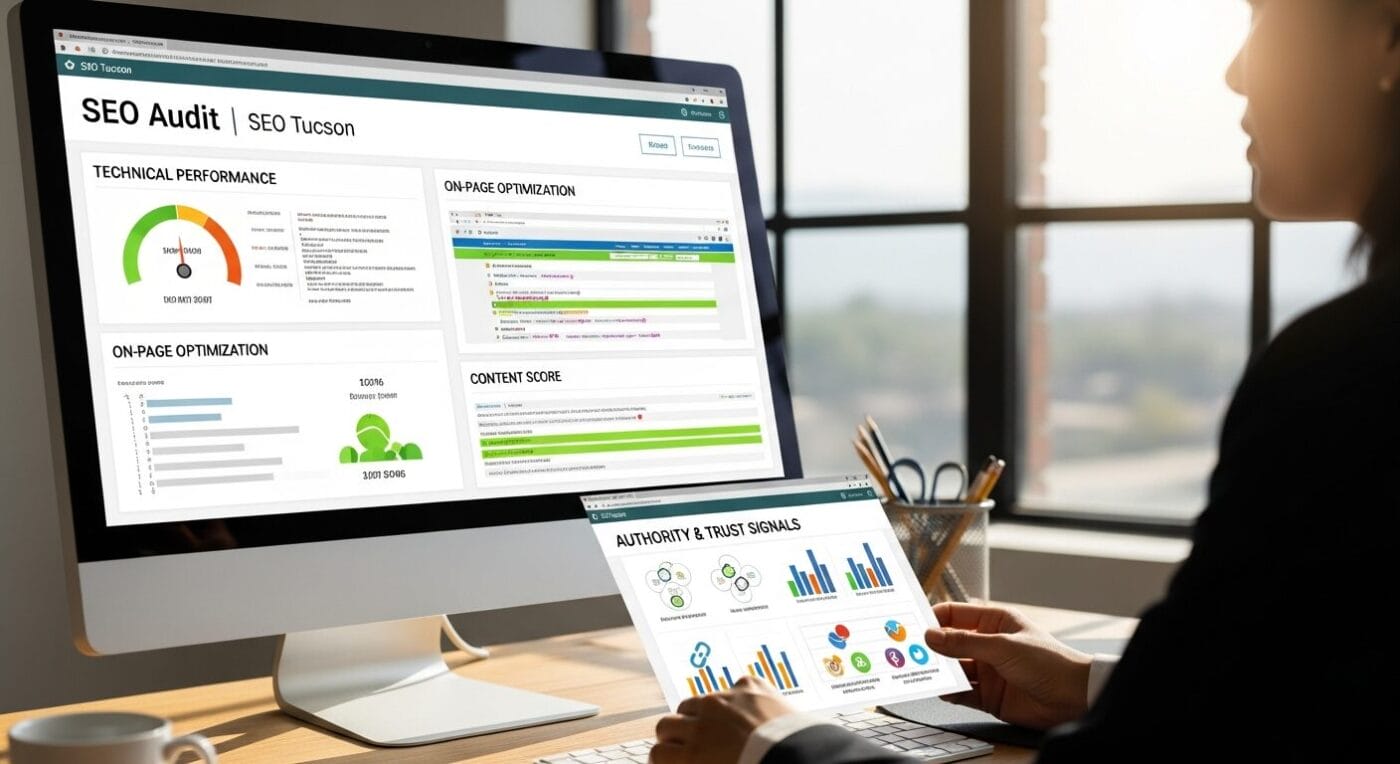
Website Traffic Analytics: How to Read Your Own Numbers
Your traffic data already tells you what to fix next. This is the routine I use to get it out, in about fifteen minutes a month, using two free Google tools.
David Cragg · Tucson SEO consultant · in search marketing since 1990
The short version
- Search Console explains the click. GA4 explains what happens after it. You need both, and most owners only look at one.
- Five numbers carry the decisions: organic sessions, organic landing pages, impressions and click through rate by query, average position, and conversions from organic.
- Read trends, not totals. Every analytics tool undercounts. The direction of the line is the signal.
- Monthly is the right cadence. Checking daily produces anxiety and bad decisions. Search does not move that fast.
- A number is only useful if it changes what you do next. If a metric never triggers an action, stop reporting it.
I have been reading search traffic reports since 1990, back when the reports were raw server logs and the search engines were Lycos and AltaVista. The tools got much better. The mistake stayed the same: business owners collect data they never look at, then make SEO decisions on gut feel anyway.
This page is the routine I run for every client on the first business day of the month. It takes about fifteen minutes once it is set up. It uses Google Analytics 4 and Google Search Console, both free, and nothing else.
What website traffic analytics actually means
Website traffic analytics is the practice of measuring four things: who arrives, which channel sent them, what they do on the site, and what that is worth to you. Everything else is detail hanging off those four questions.
Most small business sites I take over already have the data. Google Analytics is installed. Search Console is verified. Nobody has opened either one in eight months. The data is not the problem. Having a repeatable routine for reading it is the problem, and that is a much easier thing to fix.
The point of a traffic report is not to know your numbers. It is to know which one thing to work on next.
David Cragg Tucson SEO consultantThe two free tools that do almost all of the work
People spend money on analytics platforms before they have used the free ones properly. Google gives you both halves of the picture at no cost. Search Console covers everything that happens inside the search results. GA4 covers everything that happens after somebody lands on your site.
| What you want to know | Google Search Console | Google Analytics 4 |
|---|---|---|
| Where it measures | Inside Google search results | On your website |
| Search queries people used | Yes, with impressions and position | No |
| Click through rate from the results page | Yes, per query and per page | No |
| Indexing and crawl problems | Yes | No |
| What visitors did on the page | No | Yes, engagement and scroll |
| Calls, forms and other conversions | No | Yes, once events are configured |
| Traffic from channels other than search | No | Yes, all channels |
| Cost | Free | Free |
Link the two together. In Search Console, open Settings and then Associations, and connect your GA4 property. That puts Search Console reports inside GA4 so you are not switching browser tabs the whole time you work.
The five numbers I check first
I have tried longer report templates. They get skimmed and ignored. Five numbers get read, and each one leads to a specific decision.
- Organic sessions, rolling twelve months. Not last month against this month. A full year of line, so seasonality is visible and one bad week does not look like a crisis. In GA4: Reports, then Acquisition, then Traffic acquisition, filtered to Organic Search.
- Top twenty organic landing pages. Traffic is never evenly spread. On most small business sites, five pages carry more than half the organic traffic. Those five pages deserve most of your attention, and you cannot know which they are without looking.
- Impressions and click through rate by query. This is the Search Console Performance report. High impressions with a low click rate means Google is showing your page and searchers are choosing somebody else. That is a title and description problem, and it is the fastest fix in SEO.
- Average position for the keywords that make money. Ten to fifteen terms, tracked monthly. Not two hundred. The list should be short enough that you recognize every term on it.
- Conversions from organic search. Calls, form fills, bookings. Without this number, everything above is audience measurement rather than business measurement.
If you only fix one thing this month
Set up conversion events in GA4 for phone clicks and form submissions. Until those exist, no traffic report you run can tell you whether SEO is producing revenue or just visitors. It is an afternoon of work and it changes every conversation you have about your website after that.
How I read a GA4 report in ten minutes
Same five steps, same order, every month. The order matters because each step narrows the next one.
1. Set the date range properly
Last full calendar month, compared to the same month last year. Not the previous month. Comparing July to June tells you about summer. Comparing July to last July tells you about your website.
2. Isolate organic search
Reports, Acquisition, Traffic acquisition. Then filter the session default channel group to Organic Search. Paid, direct and referral traffic have their own stories and mixing them in hides the SEO signal completely.
3. Pull the landing page report
Reports, Engagement, Landing page, still filtered to organic. Sort by sessions. Look at the top twenty rows and mark any page whose sessions fell more than about twenty percent year over year. Those are your refresh candidates.
4. Check engagement on the pages that matter
Average engagement time and engagement rate on your top landing pages. A page pulling good traffic with poor engagement is usually a search intent mismatch: the page ranks for a query it does not actually answer. That is a content problem, not a technical one.
5. Read conversions by landing page
Which organic entry pages produce calls and forms, and which produce nothing. A page with heavy traffic and zero conversions either has the wrong audience or a broken path to contact. Both are fixable once you can see it.
Set this up once and skip steps one and two forever. Build the whole view in Google Looker Studio, connect GA4 and Search Console as data sources, and save it. Next month you open one link instead of clicking through six menus. It is free and it takes about an hour.
How I read Search Console
Search Console is where the SEO diagnosis actually happens, because it is the only place you can see the gap between being shown and being chosen.
Performance report: find the click gap
Open Performance, turn on all four metrics, and set the range to the last three months compared to the previous period. Sort queries by impressions. Now look for rows with heavy impressions and a click through rate well under what the position would predict. A page sitting in position four or five should be earning a meaningful share of clicks. If it is not, the title tag and meta description are failing to make the case. Rewrite them and check back in two weeks.
Pages report: confirm Google can index you
Indexing, then Pages. Anything under Not indexed that you actually want ranking is an emergency, because no amount of content or link work will help a page Google has not indexed. Common causes are a stray noindex tag, a robots.txt rule left over from a staging site, and canonical tags pointing somewhere unintended. This is core technical SEO territory.
Core Web Vitals: page experience
Google grades three things: how fast the main content loads, how quickly the page responds to a tap or click, and how much the layout jumps around while loading. The current thresholds are 2.5 seconds, 200 milliseconds and 0.1 respectively, documented in Google Search Central. Failing pages are competing with a weight on them. On WordPress sites the usual culprits are uncompressed images, plugin bloat and cheap shared hosting, which is why website design and SEO cannot be separated.
Manual actions: check it monthly, hope it is empty
Security and Manual actions. It is almost always empty. On the rare occasion it is not, it explains a traffic collapse that nothing else can, and you want to know within weeks rather than months.
Four patterns in the data, and what each one means
After enough of these reviews you stop reading numbers and start recognizing shapes. These four cover most of what you will see.
Impressions up, clicks flat
Google is showing your page more and searchers are not picking it. The ranking is fine. The pitch is not. Rewrite the title tag and meta description to match what the searcher is actually trying to do, then recheck in two weeks. This is the highest return fix in the whole list.
Clicks up, conversions flat
You are attracting the wrong people, or the right people are hitting a dead end. Check which queries drive the new clicks. Informational terms bring readers, not buyers. If the queries look commercial, the problem is on the page: buried phone number, long form, unclear next step.
Traffic down, position steady
Your ranking held but the results page changed underneath you. An AI Overview, a map pack or a video carousel is absorbing clicks above you. Compare impressions against clicks in Search Console to confirm. The response is usually to earn the feature rather than fight it.
One page falls, the rest hold
This is good news, because it is contained. A sitewide drop points at a technical or algorithmic cause. A single page drop points at that page: stale content, a competitor who published something better, or a broken internal link that cut off its support.
Mistakes I find in almost every account
- No conversion events configured. The single most common gap. The account reports sessions forever and can never answer whether SEO paid for itself.
- Internal traffic never filtered out. You, your staff and your web developer are inflating the numbers, and on a low traffic site the distortion is large.
- Reporting month over month only. Every seasonal business looks like it is dying in January and booming in spring. Year over year comparison removes the illusion.
- Tracking two hundred keywords. Nobody reads a two hundred row report. Fifteen terms that map to actual services will change your decisions. The rest is noise dressed as thoroughness.
- Chasing rankings for terms nobody buys from. Position one for a term with no commercial intent is a trophy, not a lead source.
- Redesigning or migrating without a baseline. Export your rankings, top landing pages and traffic before the work starts. Without a before, you cannot prove or diagnose the after. I have seen redesigns cut organic traffic in half with nobody able to say when it began.
- Treating analytics as reporting rather than deciding. If a report never causes anyone to do anything differently, it is a ritual. Cut it.
Where traffic analytics fits into a full SEO audit
Analytics tells you what is happening. An audit tells you why. They are different jobs and they need each other.
The monthly review on this page is the ongoing measurement layer. It surfaces symptoms: a page slipping, a click rate falling, a conversion rate that will not move. When a symptom does not have an obvious cause, that is when a full SEO audit earns its keep, because the audit examines the whole site systematically rather than the pages that happen to be visible in a report.
In practice I audit a site once when I take it on, then again annually, and I run the monthly analytics review in between. That combination catches slow problems early and avoids the expense of auditing constantly. More on the audit side of this in the rest of the SEO audit tips collection.
Want somebody to read your numbers with you?
I am a one person shop in Tucson. You work with me, not an account manager. I will open your GA4 and Search Console, tell you plainly what the data says, and give you the priority list. It is $1,000 a month, month to month, and there is no contract to sign.
Or call or text me directly: (520) 207-6000

Who wrote this
I am David Cragg. I have worked in search and internet marketing since 1990, which means I was optimizing pages before Google existed. I hold a BA in Economics from UCLA and an MBA in Marketing from the University of Washington. I founded and sold two internet marketing companies, Lotus411 and MSD2D.
Today I consult on my own for a small number of small businesses in Tucson and Southern Arizona. I run these traffic reviews myself every month for every client, which is why this page reads like a working procedure rather than a survey of the field.
Related reading
SEO audits
The full systematic review: technical health, on page, content, links and local signals, delivered as a prioritized action list rather than a document.
Technical SEO
Indexing, crawl budget, site speed, Core Web Vitals and schema. The layer that decides whether your content ever gets a fair hearing.
Search intent
Why a well optimized page still fails to rank when its format does not match what searchers on that query actually want.
Advanced SEO glossary
Plain English definitions for the terms in this page and the rest of the site, from canonical tags to crawl budget.
Content creation
Writing and refreshing the pages that the analytics review flags as slipping, declining or missing entirely.
Tucson SEO services
The whole engagement: local SEO, Google Business Profile, content and technical work at a flat $1,000 a month.
Website traffic analytics: questions I get asked
What is website traffic analytics?
Website traffic analytics is the practice of measuring who arrives at your site, which channel sent them, what they do once they land, and what that behavior is worth to the business. For a small business the working set is small: organic sessions over time, the landing pages those sessions enter through, the search queries that produced them, and the share that turn into a call or a form fill. Google Analytics 4 supplies the on-site half of that picture and Google Search Console supplies the in-search half. Everything else is a refinement of those four numbers.
What is the difference between Google Analytics and Google Search Console?
Google Search Console reports what happens before the click and Google Analytics 4 reports what happens after it. Search Console shows the queries your pages appeared for, how many impressions each earned, the average position, and the click through rate, all measured inside Google search. GA4 shows sessions, landing pages, engagement, and conversions once the visitor is on your site. Neither tool answers the other tool question, which is why a traffic review that uses only one of them is half a review. Use Search Console to diagnose why people are not clicking, and GA4 to diagnose why the people who did click are not converting.
Which website traffic metrics actually matter for SEO?
Five metrics carry almost all of the decision making value. Organic sessions over a rolling twelve months show the direction of the trend rather than the noise of a single month. Organic landing pages show which specific pages are earning the traffic. Impressions and click through rate by query show whether Google is showing your page and whether searchers are choosing it. Average position for your money keywords shows competitive standing. Conversions from organic show whether any of it is producing revenue. Bounce rate, pageviews and time on page are supporting detail, not headline numbers.
How often should I check my website traffic reports?
Once a month for the full review, plus a two minute check of the Search Console indexing and manual actions reports every week. Search data is noisy day to day, so daily monitoring mostly produces anxiety and bad decisions. A month is long enough for a real signal to separate from the noise and short enough to catch a problem before it compounds. The exception is a site migration, a redesign or a Google core update, where daily checks for two to three weeks are justified because the failure modes are fast and severe.
Why does organic traffic drop when rankings stay the same?
The most common cause is a change in the search results page rather than a change in your position. An AI Overview, a local pack, a video carousel or a set of shopping results pushes the traditional blue links further down the page, so the same position number earns fewer clicks. Seasonality is the second cause, which is why every trend should be read year over year and not only month over month. Tracking problems are the third: a tag that was removed during a redesign, a consent banner change, or a filter left on the GA4 report. Compare Search Console impressions against clicks before assuming the drop is a ranking problem.
How do I know whether my organic traffic is converting?
Configure conversion events in GA4 for the actions that actually represent money in your business, then segment those conversions by the organic search channel. For most small service businesses the events worth tracking are contact form submissions, clicks on a phone number link, clicks on an email link, and completed bookings. Until those events exist, GA4 reports audience size and nothing about business value. Once they exist you can divide conversions by organic sessions to get an organic conversion rate, and that single number tells you more about SEO performance than any ranking report.
Is GA4 traffic data ever wrong?
GA4 numbers are directionally reliable and rarely exact. Ad blockers, privacy browsers, cookie consent refusals and modeled data all mean the reported session count understates reality, typically by a meaningful margin. Search Console counts are also approximate and are filtered for privacy on low volume queries. This is not a reason to distrust the tools. It is a reason to read trends rather than absolute totals, to compare like periods against like periods, and to avoid reconciling GA4 against Search Console click for click, since the two systems count different things at different moments.
Do I need paid tools like Ahrefs or Semrush to analyze website traffic?
No. Google Analytics 4, Google Search Console, PageSpeed Insights and Looker Studio are free and cover traffic analysis completely for a small business site. Paid platforms earn their cost for two jobs that Google tools do not do well: estimating what competitors rank for, and auditing backlink profiles at scale. If you are analyzing your own traffic, the free stack is sufficient. If you are trying to work out why a competitor outranks you, a paid tool saves real time.
How long does it take to see traffic change after an SEO fix?
Title tag and meta description edits usually show a click through rate change within one to three weeks, once Google recrawls the page. Technical fixes that unblock indexing can show up within days. Content rewrites and new pages generally need one to three months before position stabilizes, and competitive commercial terms can take longer. Link building is the slowest of the group. This is why a monthly review cadence works: it matches the speed at which search actually responds, and it stops you from reversing a good change before it has had time to land.
Sources and tools referenced: Google Analytics 4 · Google Search Console · Google Search Central, Core Web Vitals · Google Search Essentials, SEO Starter Guide
Written by David Cragg, Tucson SEO consultant. Drafted with AI assistance and edited, fact checked and approved by David before publication. Published May 1, 2026. Reviewed and rewritten August 14, 2026.