


Home · Services · Reputation Management
Tucson SEO · formerly Temecula SEOTucson SEO Reputation Management Services
Earn real reviews, answer them well, and control what appears when someone searches your business name. No gating, no incentives, no purchased ratings.
Reputation management is part of the $1,000 a month engagement, not a separate line item. I do the work myself: the request workflow, the response writing, the third-party profiles and the brand search results.
Request a free reputation audit
Written by David Cragg, Tucson SEO consultant, in search since 1990 · Last reviewed September 27, 2026
Key takeaways
- Reputation management here means four things: a compliant review request workflow, owner responses to every review, accurate third-party profiles, and a clean brand search result page.
- Two hard limits shape everything: the FTC's Rule on the Use of Consumer Reviews and Testimonials, and Google's policies on incentivized reviews and rating manipulation. Anything that trades a benefit for a review is off the table.
- Review gating, asking who is happy before deciding who gets the request link, is not something I will build for you.
- Most negative reviews cannot be removed. They can be answered, out-weighted by new honest reviews, and pushed down the brand search result page.
- The reputation audit before anything starts is free, and it is a real audit.
What reputation management actually covers
Most of what gets sold as reputation management is either a review request tool with a monthly fee or a promise to bury bad news. What a small local business actually needs is duller and more effective than either.
Four workstreams:
- Review acquisition. A request workflow that reaches every customer, not a hand-picked subset, with the ask timed to when the job is finished and the goodwill is fresh.
- Review response. Every review answered in the owner's voice, including the old ones. Negative reviews answered in a way that speaks to the next reader, not the angry one.
- Third-party profiles. Accurate name, address, phone, hours and services on the platforms that actually matter for your industry, and the abandoned profiles nobody remembers creating.
- Brand search results. What loads when somebody types your business name. Your site, your profile, your social accounts, and whatever else has claimed that page.
The fourth one is the one owners forget about until it hurts. Somebody hears your name from a neighbor, searches it, and makes a decision from that one screen. If a five-year-old complaint thread sits above your own website, the reviews on your profile barely get a chance to do their job.
The compliance line, before anything else
The fastest way to wreck a reputation is to try to manufacture one. Two rule sets govern this, and both have teeth.
The FTC's Rule on the Use of Consumer Reviews and Testimonials (16 CFR Part 465) took effect on October 21, 2024. It prohibits buying positive or negative reviews, insiders writing reviews without disclosing the relationship, company-controlled sites posing as independent review sources, and certain forms of review suppression.
Google's Maps user-contributed content policies separately prohibit incentivized reviews, meaning reviews influenced by payment, a discount, free goods or services, or any other benefit offered to the reviewer, and treat rating manipulation as removable content. Getting caught does not produce a warning letter. It produces removed reviews, and sometimes a suspended profile.
| Practice | Status | Why it matters to you |
|---|---|---|
| Asking every customer for a review | Allowed | The single highest-return activity available to a local business. Do it consistently and the rest mostly takes care of itself. |
| Offering a discount, gift card, or entry into a drawing for a review | Prohibited | Incentivized under Google's policy and exposed under the FTC rule. Reviews get removed and the profile gets flagged. |
| Review gating: screening for satisfaction, then sending the link only to happy customers | Not offered here | Suppresses honest negative feedback and misrepresents overall sentiment. I will not build it, whatever the software vendor promises. |
| Staff, family, or vendors leaving reviews | Prohibited | An undisclosed insider review is a rule violation, and Google reads the pattern easily. It is also the most common way a good business gets its reviews wiped. |
| Buying reviews, or paying to have a truthful negative review taken down | Prohibited | Straightforwardly illegal under the FTC rule, and every vendor selling it eventually gets the client's profile penalized instead of theirs. |
| Responding publicly to a negative review | Allowed | Your most underused tool. The response is written for the hundred people who read it later, not the one person who wrote it. |
If a competitor is buying reviews and out-ranking you, that is frustrating and it is also temporary. The correct response is a higher honest volume, not matching their behavior.
What I do each month
Review request workflow
One short link, one clear ask, sent to every completed customer. Built into whatever you already use, whether that is invoicing software, text messages or a printed card, rather than a new platform you have to log into.
Response writing
I draft responses to new reviews and work backward through the backlog. You approve or edit; I post. Five-star reviews get a real reply, not a template, because templated replies read as automated to the next customer.
Negative review triage
Every one-star gets the same treatment: figure out whether it is a real customer, decide whether it violates platform policy, write the public response, and identify the operational fix if there is one.
Third-party profile cleanup
Yelp, Bing Places, Apple Business Connect, the BBB, and whatever is industry-specific: Healthgrades for dental, Angi and Nextdoor for home services. Consistent details, current hours, claimed and controlled.
Brand search result page
Tracking what ranks for your business name, strengthening the assets you own, and building out the pages that should sit above anything you would rather people not read first.
Monthly reporting you can read
New reviews, average rating, response rate, what moved on the brand search page. One page, plain English, no dashboard login.
How I write review responses
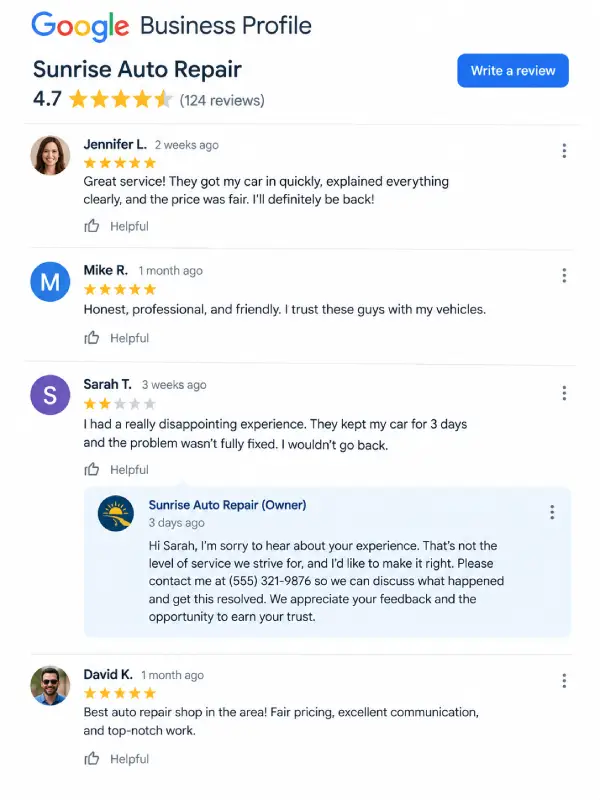
A public response is a piece of marketing copy with an audience of future customers. The person who left the review has already decided how they feel. Everyone reading it later has not.
So the response does four things:
- Acknowledges the specific complaint in the reviewer's own terms, without restating it in a way that makes it stickier.
- Supplies the missing context a stranger needs, briefly and without arguing.
- Names the concrete change, if one was warranted.
- Moves the conversation off the platform with a real contact path.
What it never does: blame the customer, cite policy at them, or use the phrase "we take all feedback seriously." Wording for eight common situations is in how to respond to a bad review.
Response behavior compounds. A profile where the owner has answered two hundred reviews over three years reads as a business run by someone who is paying attention. That impression does more for your close rate than the difference between a 4.6 and a 4.8 average.
The page that loads when someone searches your name
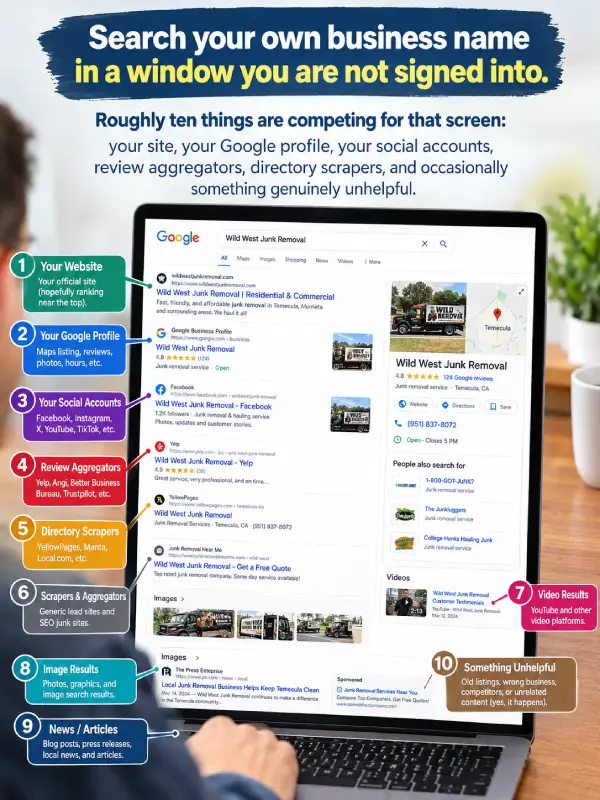
Search your own business name in a window you are not signed into. Roughly ten things are competing for that screen: your site, your Google profile, your social accounts, review aggregators, directory scrapers, and occasionally something genuinely unhelpful.
The audit sorts those into three buckets: assets you control, assets you can influence, and pages you cannot touch. Then the work is to strengthen the first bucket until it fills the visible area.
That usually means service pages that actually answer the questions people type next to your name, a bio page with real credentials, and claimed social profiles that are not abandoned. Unglamorous, and it works.
Client work, and why the examples are in California
A note on geography, because it would otherwise be confusing: I ran this practice as Temecula SEO in Southern California from 2007 to 2022, then relocated to Tucson. Several clients came with me and are still here. So the longest-running case histories I can point to are Southern California businesses, and I would rather explain that than quietly swap the city names.
Two examples, both still active:
- A junk removal company in Temecula, California. Started with a thin profile and sporadic reviews. The fix was mechanical: a request built into the end-of-job routine, and every review answered. Review volume is now the durable part of that company's local visibility, and the request workflow runs without me touching it.
- A dental practice in Murrieta, California. Ten-plus years as a client. Healthcare reviews are a different animal. Privacy constraints mean a response often cannot address the specifics at all, so the response has to reassure a stranger without confirming that the reviewer was ever a patient. That constraint shapes every draft.
Tucson clients are newer and I am not going to dress up short histories as long ones. If you want to talk to a current client before you sign anything, ask me and I will connect you.
What clients say
Four of the ten 5.0 Google reviews on my profiles, reproduced as written, uncompensated and unedited. Nine of the ten sit on the former Temecula SEO profile, which is why the names and dates run back further than the Tucson practice does.
I have been a client of David at SEO Tucson for over 10 years. His wealth of knowledge of SEO marketing has been a tremendous help for my company. He's always up to date with all the new rules and changes and always willing to try new things to help push and keep my company on the top of Google listing
Bao Nguyen, DDSPromenade Dental Care · 5.0 Google review, SEO Tucson
David at TemeculaSEO is a unique professional. He has been in the industry almost longer than the web has been around. He cares about my success and spends as much time as it takes to make my business succeed. I wish that I could afford to pay him more.
Dr. Ryan Marshall, D.C.Marshall Chiropractic · 5.0 Google review, Temecula SEO
David is great to work with. He takes his job seriously, is a wealth of knowledge not only in SEO, but also business in general. If you are looking to for someone to handle SEO for you - you can stop looking now.
Russ Colburn5.0 Google review, Temecula SEO
I made a decision to Hire David, with Temecula SEO about a year ago now, it has changed the presence of my company online greatly. I would highly recommend giving david a chance if you are looking for an honest SEO company.
Jordan Johnson5.0 Google review, Temecula SEO
What it costs
$1,000 a month, month to month
Everything on this page is inside that fee. Reputation management is not an add-on, and Google Business Profile management is not sold separately either. No contract, no setup charge, no per-review pricing, and no software license you keep paying for after we stop working together. The full breakdown is on the pricing page.
The reputation audit before we start is free: the actual audit, with the brand search page, the review history and the third-party profiles I find, not a teaser PDF.
Related services and reading
Two neighboring pages handle questions that overlap with this one:
Google Business Profile management
Google's own review policies, the flagging and removal workflow inside the profile, categories, photos and posts.
Tucson local SEO
How reviews interact with Map Pack and local ranking, proximity, and the rest of the local algorithm.
If you would rather start on your own: how to get more Google reviews without breaking the rules and getting a fake review removed.
Where I work
- Tucson
- Oro Valley
- Marana
- Catalina Foothills
- Sahuarita
- Green Valley
- Vail
- South Tucson
- Corona de Tucson
- Oracle
- Tubac
- Benson
Reputation management FAQ
Is reputation management a separate fee?
No. It is part of the $1,000 a month engagement, along with local SEO, Google Business Profile management, content and technical work. There is no add-on pricing, no per-location charge, and no review-platform license. The engagement is month to month with no contract.
Is it legal to ask my customers for reviews?
Yes, and you should. Asking is permitted by both the FTC rule and Google's policies. What is prohibited is offering anything of value in exchange, such as payment, a discount, a free service or a raffle entry, and asking only the customers you expect to be happy. Ask everyone, ask the same way, and keep no record of who you think will say what.
What is review gating, and why won't you set it up?
Gating is a two-step funnel: first a private question asking how the experience went, then the public review link shown only to the customers who answer positively. Unhappy customers get routed to a private feedback form instead. Vendors still sell it as "reputation protection." It suppresses honest negative reviews and misrepresents overall sentiment, which is what the FTC rule's review suppression section addresses. I will not build it, and if you have one running I will ask you to turn it off before I take the engagement.
A review is false and damaging. What are my realistic options?
Three, roughly. Respond publicly, which is nearly always the right first move and the only one fully under your control. Report it, if it breaks a platform content policy such as fake engagement, a personal attack, off-topic content, or a reviewer who was never a customer; the step-by-step process inside Google Business Profile is covered on the Google Business Profile page. Or pursue it legally, if the review states a false fact rather than an opinion, which is a lawyer's question and not mine. A truthful negative review, however unfair it feels, is not removable, and paying someone to make it disappear is itself a violation.
How long does it take to bring a low average back up?
It depends almost entirely on your volume. A business with 40 reviews at a 3.6 average needs roughly 30 new five-star reviews to reach 4.3, which is three to six months of consistent asking for most service businesses. A business with 400 reviews moves much more slowly, because the denominator is large. Recency helps you in the meantime: the reviews a customer actually reads are the recent ones, so a steady flow of new five-star reviews changes the impression well before the headline number catches up.
Do I need to respond to every review, including the old ones?
Yes to new ones, and yes to the backlog if it is reachable. Responses are permanent, public, and read by people deciding whether to call you. A profile with 90% of reviews answered reads differently than one where only the angry ones got a reply, because answering only complaints makes the complaints look like the important part. I work backward through the backlog in batches rather than all at once, so the response dates do not all land on the same day.
Which review sites matter besides Google?
It varies by industry more than most guides admit. For home services: Angi, Yelp, Nextdoor and the BBB, plus Facebook recommendations, which still drive real calls in Tucson neighborhoods. For dental and medical: Healthgrades, Zocdoc and Vitals, where reviews are read by people who have already decided to switch providers. For restaurants and retail: Yelp and TripAdvisor. For everyone: Apple Business Connect and Bing Places, because nobody claims them and they show up in a brand search. The audit tells you which four matter for you, and we ignore the rest.
Can you change what shows up when someone searches my business name?
Partly, and the honest answer is that "partly" is usually enough. You control your website, your Google profile and your social accounts, which typically make up most of the visible area of that first screen. You cannot remove a third-party page you do not own. What you can do is make the assets you own strong and numerous enough that the unhelpful result moves below where people stop looking. That work is measured in months, not days.
Can you get a negative news article or a complaint-site page taken down?
Almost never, and anyone promising otherwise is selling you something. Legitimate news outlets do not remove accurate reporting, and complaint sites are structurally built to resist removal requests, with some of them monetizing the request itself. Legal demand letters to these sites frequently make the situation worse by generating a second page about the demand. The workable approach is suppression through owned assets, plus a page on your own site that addresses the underlying issue directly, which often outranks the complaint for the same query.
Do AI assistants use my reviews when they recommend businesses?
They appear to, though nobody outside those companies can say exactly how much weight reviews carry. Practically, the systems answering "who is a good plumber in Tucson" draw on the same public sources a person would, meaning your profile, your reviews and the pages that describe your services, so review volume, recency and the specific language customers use in them all feed the same pool. What this changes about the work: almost nothing. A profile with a high volume of recent, specific, answered reviews is the goal either way.
Sources
- Federal Trade Commission, The Consumer Reviews and Testimonials Rule: Questions and Answers. The rule took effect October 21, 2024.
- Electronic Code of Federal Regulations, 16 CFR Part 465, Rule on the Use of Consumer Reviews and Testimonials, including § 465.5 on insider reviews and § 465.7 on review suppression.
- Google, Prohibited and restricted content. Maps user-contributed content policy, including fake engagement and incentive solicitation.
- Google, Incentivized or biased reviews. Maps user-contributed content policy definition.
Tucson SEO, formerly Temecula SEO
David Cragg, Tucson SEO consultant, in search since 1990
Tucson, Arizona · Serving Tucson and Southern Arizona
Phone: (520) 207-6000 · $1,000 a month, no contract
On how this site is written: I use AI tools to draft and to check my own work. AI does not supply the facts about your business, it does not invent sources, and nothing goes up here that I have not read first. If you find a claim on this site you can't verify, call me and I'll fix it or pull it.