
How Do You Push Down Negative Search Results About Your Business?
You usually can't delete the page. You can make it the fourteenth thing a customer sees instead of the second.

I'm David Cragg. I've worked in search since 1990, and the most anxious call I get is some version of "there's an old story about us on page one, can you make it go away?" The honest answer is that Google removes very little on request, and what it does remove follows written rules. What you can almost always do is push down negative search results by filling page one with pages that are accurate, current and yours.
This page covers results that aren't Google reviews: old news stories, complaint sites, forum threads and outdated pages that still rank for your business name. Reviews on your Google Business Profile have their own rules, and so does anything that crosses into defamation. Both are covered in getting a fake review removed, including the point where it becomes a legal question instead of an SEO one. I won't repeat that here.
Where Google's documentation says something plainly, I've said so and linked it at the bottom. The timelines and the order I build things in come from my own work, and I've labeled them that way. Those two kinds of claims aren't equally reliable, and you should know which one you're reading.
The short version
- Google removes a short list of things. Personal contact details, government ID numbers, content on sites that charge for removal, and pages that have already changed at the source. An accurate article or an angry forum post isn't on the list.
- Ask the source before you ask Google. An editor can add an update. A moderator can lock or remove a thread. Once the page changes, Google has a tool to catch up.
- Displacement is the main work. Every page-one spot held by your own site or a real profile is a spot the negative result can't hold.
- Plan in months, not days. Weak pages drop in weeks. A story on a strong news site can take a year, and some never leave page one.
- Skip the shortcuts. Fake takedown notices, fake sites and paid "deletion" services add a second problem on top of the first.
What Counts as a Negative Search Result?
Search your business name the way a stranger would: in a private browser window, signed out, once on your phone and once on a computer. Then search it again with "reviews," "complaints" and "scam" after it. Those four searches are what a careful customer runs before they call. Anything on the first page that hurts you usually falls into one of these groups:
- Old news stories. A TV consumer segment or a newspaper item from years ago, still ranking because news sites carry a lot of authority with Google.
- Complaint sites. Boards built for posting grievances about companies. Many of them never remove a post, even after the problem is fixed.
- Forum and Reddit threads. A neighborhood thread where someone asked about you and the top answer was a bad one.
- Outdated pages. An old directory listing with the former owner's name, a closed location, old prices, or a page from your previous website that is still being served somewhere.
- Pages showing personal details. Corporate-record and people-search sites that list the owner's home address, which is common when a service business is registered at the owner's house.
Google reviews are left off this list on purpose. They sit on your profile rather than in the regular results, and they're handled through a different process.
What Will Google Remove, and What Won't It?
Google publishes its removal rules. Every row in this table comes from those policies, applied to the results business owners ask me about most often.
| What's showing up | Will Google remove it? | Where to ask |
|---|---|---|
| The owner's home address, personal phone or personal email on a page | Often, under its personal information policy | Results about you, or the personal information removal form |
| A Social Security, driver's license or passport number | Yes | Results about you, which added government ID numbers in February 2026 |
| A site that demands payment to take content about you down | Possibly, but the policy excludes business review sites | The request for sites with exploitative removal practices |
| A page its owner has already deleted or changed | Yes, Google refreshes or drops the result | The Refresh Outdated Content tool |
| An accurate news story about the business | No | Ask the publisher for an update instead |
| A negative post on a complaint site | No | Reply on the site, then outrank it |
| A forum or Reddit thread | No | The author or the forum's moderators |
| False statements of fact that damage the business | Only through a legal process | See the legal section of the fake review guide |
Two of those rows trip people up. Google's personal information policy and the Results about you tool are built for individuals. They help when your home address shows up on a corporate-record site because the LLC is registered at your house. They won't remove a page because it mentions or criticizes your company. And the exploitative removal practices policy is aimed at sites that charge people to take down personal content such as mugshots. Google's own request form says the site can't be a business review site, so a complaint board about your company almost never qualifies.
The tool most owners have never heard of is the Refresh Outdated Content tool. If a publisher has changed a page or taken it down and Google is still showing the old version, you can ask Google to catch up. It only works after the change has happened at the source. It won't touch a page that's still live and unchanged.
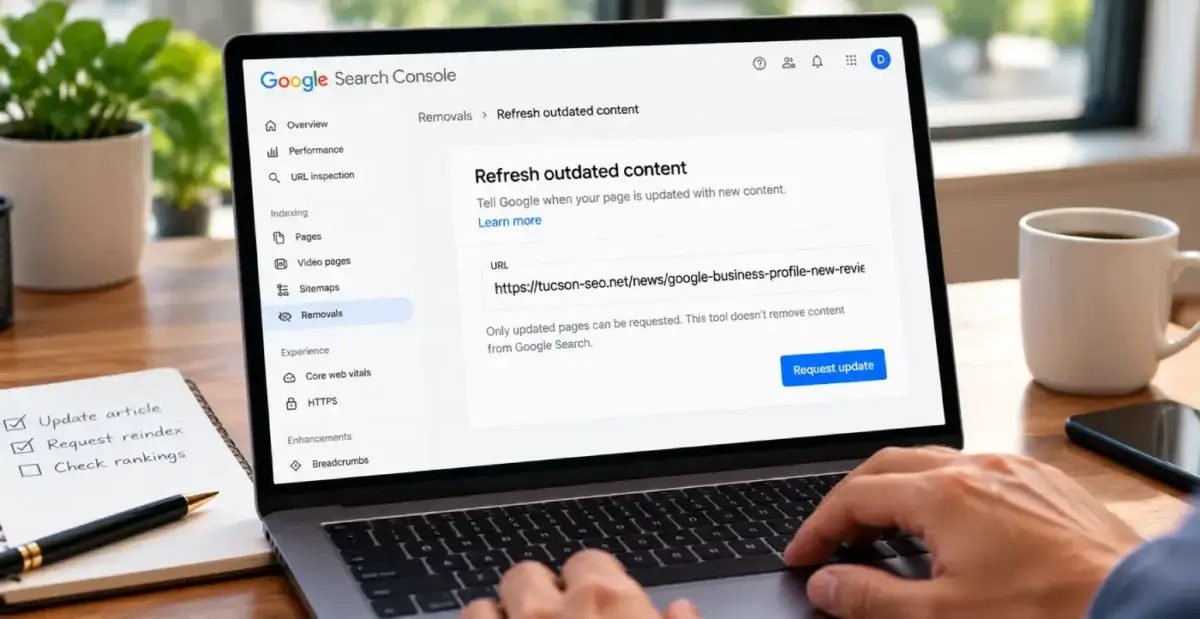
The Refresh Outdated Content tool only works after the publisher has changed or removed the page. Ask the source first, then ask Google to catch up.
Can You Get the Page Changed at the Source?
This is the step most people skip, and it's the only one that can make a result disappear completely. Google indexes what's on the page. Change the page and the result follows.
How do you ask a news site to update an old story?
Don't ask for the story to be deleted. Most newsrooms won't do it, and the request can become a story of its own. Ask for an update. If the complaint was resolved, the lawsuit was dismissed, or the owner named in the story sold the business years ago, write to the editor and attach the documents. A short note at the end of the article saying the matter was resolved changes how every future reader sees it. Some outlets have a formal process for reviewing old stories, so ask whether they do.
What about forums and complaint sites?
On a forum or a Reddit thread, the person who posted can edit or delete it, and moderators can remove posts that break the forum's rules. A polite message works more often than owners expect, especially once the problem has been fixed. Complaint sites are harder. Many never remove posts, and some sell programs that add a better-looking label to your listing. I don't recommend paying them. One calm, factual reply on the post, signed by the owner, does more for the person reading it.
What if the outdated page is one you control?
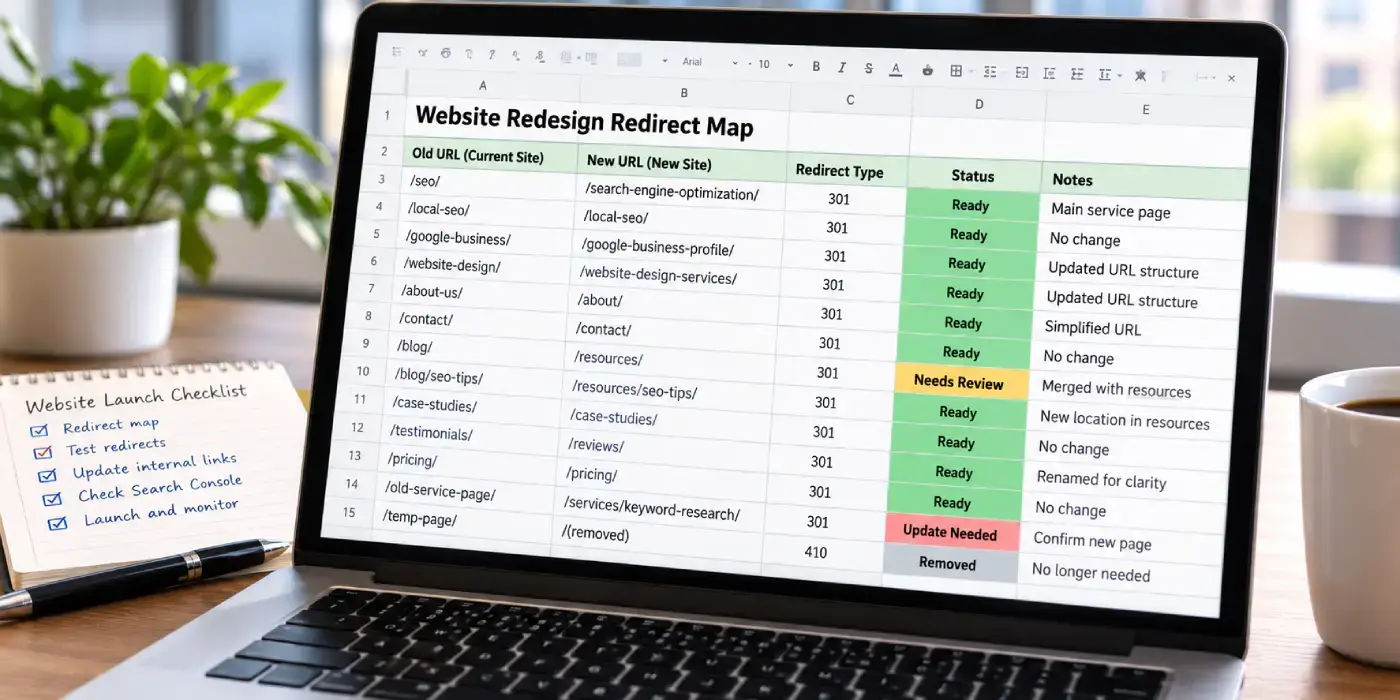
Old websites, abandoned social accounts and directory listings you set up years ago are the easiest wins. Update them, point them at your current site, or take them down. If you own the old site, a page-to-page 301 redirect or a noindex tag takes the URL out of results at the next crawl, and Search Console's Removals tool can hide it in the meantime. If someone else's page has since been updated, that's when the Refresh Outdated Content tool earns its keep.
How Do Your Own Pages Push a Negative Result Down?

Profiles you keep current, linked from your website and named the same way everywhere, take page-one spots away from a negative result.
A search for your business name returns a limited number of regular results on page one, usually alongside your Business Profile, a "People also ask" box and often an AI Overview. Every spot held by something accurate and current is a spot the negative result can't hold. That's the whole mechanism. Google isn't punishing the bad page. It's picking better answers to a search about you, and your job is to supply them.
These are the assets that work, in the order I build them. The order is my practice, not a Google rule.
- Your own website, with more than one page that answers a search for your name. An About page with the owner's name and history, a team page, a page for each service, and a news or press page. Google often shows several of your pages as sitelinks under the homepage, which takes up a lot of the screen on its own.
- Your Google Business Profile, complete and active. It usually holds the right side of the page on a computer and the top of the page on a phone.
- Two or three social profiles you'll actually keep up. LinkedIn for the company and the owner, a Facebook page, and a YouTube channel if you'll post even a few videos a year. Abandoned profiles rank poorly and look worse when they do.
- License and membership pages. A state license record, a trade association member page or a listing in your local chamber of commerce directory carries authority Google already trusts.
- Real local coverage. Sponsoring a youth league, speaking to a Tucson business group, or being quoted in a local story about your industry. One genuine local article can outrank a complaint page by itself.
Why does connecting these pages matter?
Google has to understand that the LinkedIn page, the Facebook page and the chamber listing all belong to the same business as your website. Link to each of them from your site, keep the business name identical on all of them, and list them in your Organization or LocalBusiness structured data with the sameAs property. That markup is part of my technical SEO service, and it's one of the cheapest improvements you can make to a search for your name.
Should you publish a page about the problem itself?
Sometimes. If a story from 2019 is the second result for your name, an honest page on your own site with a title like "What happened in 2019 and what we changed" can outrank it, because it answers the same question with newer information. It also puts your side in front of the reader. The trade-off is that you're giving the issue a page of its own. I only suggest it when the negative result is already on page one and isn't going anywhere soon. If it's sitting on page two, leave it alone.
How Long Does It Take to Push Down Negative Search Results?
Longer than anyone wants. Google publishes nothing on this, so these ranges are mine, from doing the work. They depend on how strong the negative page is and how often people search your name.
| Type of result | Typical time to leave page one | What decides it |
|---|---|---|
| An old directory listing or a thin forum thread | A few weeks to three months | Whether you've built two or three solid pages to replace it |
| A complaint-site post | Three to six months, sometimes longer | Complaint sites rank well for "[name] complaints" and "[name] scam" |
| A Reddit thread | Three to nine months | Reddit ranks strongly in Google, and an active thread holds its place longer than a dead one |
| A story on a major news site | Six to twelve months, and some never move | News domains are among the strongest sites on the web |
Two things change those numbers. A business name shared with other companies or people is harder, because Google mixes the results together. And a business almost nobody searches by name gives Google little reason to rearrange the page. In that case the fix is more customers finding you in the first place, which is local SEO work rather than reputation work.

Push-down work is slow and steady. Checking the same four searches each month shows whether it's working.
What Should You Never Do to Bury a Bad Result?
- Don't file fake copyright takedowns. Some reputation firms copy a negative article onto another site, backdate it, and file a takedown claiming the original copied them. It's fraud, the notice is signed under penalty of perjury, and Google sends copies of takedown notices to the public Lumen database, where anyone can read them.
- Don't build fake sites or fake press. Thin sites made only to rank for your name break Google's spam policies, and Google has said those policies apply to its AI Overviews and AI Mode as well.
- Don't pay a site to take content down. Paid removal is the business model, and paying once tells them it works.
- Don't lead with a lawsuit threat. A demand letter can end up quoted in a follow-up story or posted on the complaint site, and then it ranks too. If you believe it's a legal matter, talk to a lawyer before you write anything.
- Don't buy a promise to delete. Nobody can delete an accurate news story from Google on demand. Firms that promise it are either using one of the tactics above or selling a push-down they can't guarantee.
How Do You Watch for New Negative Results?
Once page one looks right, keeping it that way takes about twenty minutes a month.
- Run the four searches monthly. Your business name, then your name with "reviews," "complaints" and "scam," signed out, in a private window.
- Set Google Alerts for the business name and the owner's name.
- Turn on Results about you for the owner, so Google tells you when a new page shows your home address or phone number.
- Watch Search Console. In the Performance report, filter queries that contain your business name. If "[your name] scam" or "[your name] lawsuit" starts picking up impressions, people are already looking for it, and you'll know before it reaches page one.
Is Something on Page One Hurting Your Business Right Now?
If a story, a complaint post or a thread is sitting under your name today, call me and read me the results. I can usually tell you in a few minutes whether you're looking at a removal, a change at the source or a push-down, and those three have very different timelines. The first look is free and there's nothing to sign.
Or call (520) 207-6000. You get me, not an account manager.
What's Different About This in Tucson?
Three things about brand searches for Southern Arizona businesses that the national guides don't mention.
A smaller media market keeps old stories on top. Tucson has one daily paper, the Arizona Daily Star, and a handful of local TV newsrooms. A consumer story about a big-city business competes with thousands of other pages. A story about a Tucson business often competes with almost nothing, so it can hold a top-five spot for your name for years. That's my observation rather than a published rule, but it's why I start displacement work earlier here than I would in a large metro.
Regional names collide. Sonoran, Saguaro, Catalina, Desert, Old Pueblo, Santa Rita. A lot of Tucson business names share the same handful of words, and a search for "Sonoran" plus your trade can pull in another company's complaint. Before you try to push a result down, make sure it's actually about you. If it's about a similarly named business, the fix is making your own name easier to tell apart: the full name everywhere, your town on every profile, your license number on the site.
Corporate records publish home addresses. The Arizona Corporation Commission's public business records list a statutory agent and the company's principals, often with addresses, and record-copying sites republish them. For a home-based trade, that can put the owner's house under the business name. A statutory agent service keeps future filings cleaner, and Results about you handles the copies already showing in Google.
Would You Rather Not Do This Yourself?
Brand-search cleanup is part of ordinary reputation management for my clients, and it's included in the fee rather than billed as a project. It rarely stands alone. The pages that do the pushing come out of content creation, the profile that holds the top of the page is Google Business Profile management, the sameAs markup that ties your profiles together is technical SEO, and if your name barely gets searched, the real fix is local SEO that brings more people to it. If you want the prioritized list before you spend anything, start with an SEO audit. When a review rather than a page is the problem, how to respond to a bad review is the place to start.
It's all inside the same $1,000 a month, no contract. I work across Oro Valley, Marana, Catalina Foothills, Sahuarita, Green Valley and Vail, and I take one client per competitive niche per zone. Here's why people work with me, and here's the background you can go check.
What Do Clients Say About Working With David?
Four of the ten reviews on my Google profiles, quoted in full. Most were left on the Temecula SEO profile during the Southern California years, before the practice moved to Tucson in 2022.
David built and developed the website for my business. His customer service and expertise are superior to anyone else I had previously used. How many web development guys had I been through that promise the moon, work hard for a short while, then become difficult to get a hold of later? I'll tell you: there were 9 in 7 years! Temecula SEO worked with us closely, is VERY knowledgeable and computer savvy! It's so nice to have a custom website built; and, actually see it rank well on-line! If you want an SEO guy you can count on, David with Temecula SEO is your man!
Leo Rich Severns Master Technician · Temecula SEO
I made a decision to Hire David, with Temecula SEO about a year ago now, it has changed the presence of my company online greatly. I would highly recommend giving david a chance if you are looking for an honest SEO company.
Jordan Johnson Temecula SEO
David has been a huge help to my business. He's knowledgeable, responsive, and consistently delivers great work. Since working with him, we've seen strong improvements and he continues to go above and beyond to help our business grow. Highly recommend David and SEO Tucson to anyone looking for someone who truly cares about getting results.
Weston Molitor Wild West Junk Removal · SEO Tucson
We have worked with David for over a year now and he is great to work with. David has built us a great new website that we love and our Google ranking has improved significantly. David is a great guy and works day and night to help you. I highly recommend Temecula seo. Thank you David for your hard work.
Jason Moat Temecula SEO
What Do People Ask About Pushing Down Negative Search Results?
Can I pay Google to remove a negative search result about my business?
No. Google doesn't sell removals, and ad spending has no effect on regular search results. Google removes content only when it meets one of its published policies, such as exposed personal contact information or government ID numbers, or after a valid legal request. Anyone who says they can buy a removal from Google is describing something Google doesn't offer.
Will Google remove an old news article about my business?
Not if the article is accurate and still live. Ask the publisher to add an update or correction instead, with documents showing how the matter was resolved. If the publisher changes or removes the article, use Google's Refresh Outdated Content tool so the search result catches up with the page.
Does Google's Results about you tool work for business information?
It's built for individuals. It can remove results that show the owner's home address, personal phone number, personal email or government ID numbers, which helps when a business is registered at the owner's home. It won't remove a page because it mentions or criticizes the business.
How many pages does it take to push a result off page one?
There's no fixed number, because it depends on how strong the negative page is. In practice it usually takes a website with several pages that rank for your name, an active Google Business Profile, and three to five real profiles or local mentions that link back to your site. One new page rarely moves a strong news story on its own.
How long does it take to push down negative search results?
In my experience, weak pages such as an old directory listing can drop off page one in a few weeks to three months. Complaint-site posts and Reddit threads usually take three to nine months. A story on a major news site can take six to twelve months, and some never leave page one. Steady work beats a burst of activity.
Do reputation companies that promise to delete search results actually work?
Be careful. Nobody can delete an accurate news story or complaint post from Google on demand. Firms that promise deletion are either describing a push-down campaign they can't guarantee or using tactics like fake copyright takedowns, which are fraud and end up published in the Lumen database. Ask exactly how they plan to do it before you pay anything.
Should I reply to a post about my business on a complaint site?
Usually yes, once, calmly and factually, signed by the owner. Explain what happened and what you changed, and leave the argument out. Most complaint sites won't remove a post even after you resolve the problem, so your reply is what the next reader sees under it.
Will pushing a result down keep it out of AI answers?
Not necessarily. AI tools can cite a page that sits on page two of Google. What lowers the odds is the same work that pushes the result down: current, accurate pages about your business that answer the questions people ask. Ask ChatGPT or Google's AI Mode about your business every few months and note which sources it cites.
What if the negative result is an old page I control?
Fix it yourself. Update the page, redirect it to its current equivalent with a 301 redirect, or add a noindex tag. Search Console's Removals tool can hide the URL temporarily while Google recrawls it. Old websites and abandoned profiles are the fastest results to clear because you don't need anyone's permission.
Where Does the Information on This Page Come From?
The removal rules on this page come from Google's own documentation. The timelines and the build order are my judgment and are labeled that way. If a linked page disagrees with anything here, the linked page is the authority.
- Google Search Help: Remove personally identifiable info or doxxing content — what personal information Google will consider removing, and the Results about you path.
- Google Search Help: Remove content about you on sites that charge for removal — the exploitative removal practices policy and its business review site exclusion.
- Google Search Help: Refresh Outdated Content tool — when the tool works and when it won't.
- Google Search Help: Content policies for Google Search — the overall rules for what Google removes from results.
Want to Know Which Results Can Actually Be Moved?
Send me your business name and your town. I'll run the four searches a customer runs and sort what's on page one into three piles: what Google might remove, what the source might change, and what has to be outranked, with a rough timeline for each. If it's something you can handle yourself in an afternoon, I'll say so.
Or call (520) 207-6000 and read me what you're seeing.
SEO Tucson, formerly Temecula SEO
Serving Tucson and Southern Arizona
Phone: (520) 207-6000
Consultant: David Cragg, in search since 1990
Written by David Cragg, Tucson SEO consultant, in search since 1990. Before Temecula SEO and SEO Tucson I founded and sold two internet marketing companies, Lotus411 and MSD2D, so I've been reading search results about businesses, my own included, for a long time.
On how this site is written: I use AI tools to draft and to check my own work. AI does not supply the facts about your business, it does not invent sources, and nothing goes up here that I have not read first. If you find a claim on this site you can't verify, call me and I'll fix it or pull it.
Page last reviewed October 26, 2026 by David Cragg. Google's removal policies and tools change from time to time; the linked help pages are the authority if they disagree with this page.