How to Respond to a Bad Review (With Wording for 8 Situations)
A response library, not a pep talk. Eight situations that actually land on Tucson business profiles, with wording you can adapt in two minutes and the sentences that will hurt you for years.
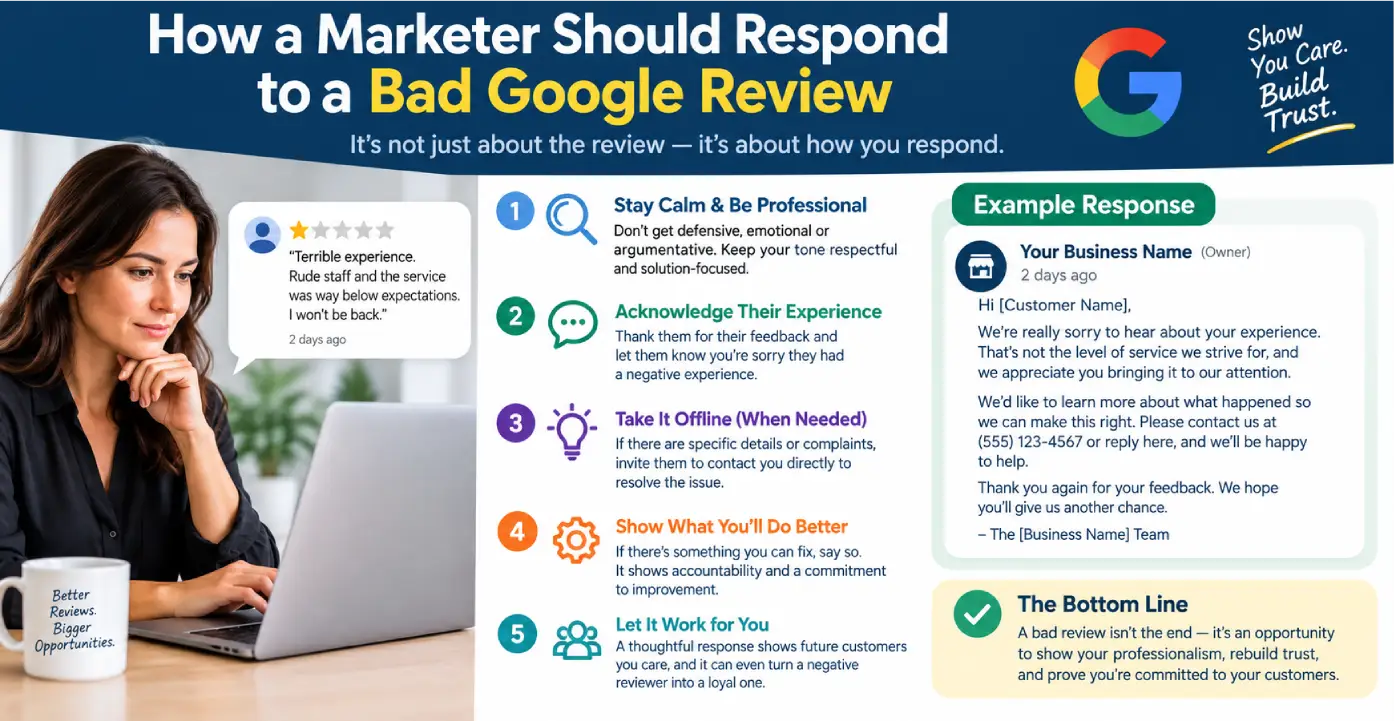
Most advice about negative reviews stops at “stay professional and take it offline.” That is correct and completely useless at 9:14 on a Monday morning when you are staring at a one-star review and your hands are shaking. I have been in search marketing since 1990, I have managed local profiles through every version of Google’s review system, and I have written more of these replies than I can count — for a chiropractor, a dentist, a junk-removal crew, an HVAC company that grew from one truck to thirteen. The pattern never changes: the reply is not for the reviewer. It is for the next twenty people who read it.
The short version
- Write to the reader, not the reviewer. The angry customer is gone. The person deciding between you and a competitor is still reading.
- Three to five sentences, every time. A long reply looks like a defense. A short reply looks like a business that handles things.
- Never rebut facts in public. Correct the record once, briefly, then move the conversation to a phone number.
- Reply within 24 hours, not 24 minutes. Roughly half of reviewers now expect a response the same day or the next.
- Flagging and replying are separate decisions. Do both when a review violates policy. Flagging alone leaves the review sitting there unanswered while Google takes weeks.
Why the reply matters more than the star
A single one-star review inside a healthy profile costs you almost nothing. What costs you money is a one-star review with no owner reply, or worse, an owner reply that reads like a lawsuit brief.
Two things happen when you respond well. The first is human. BrightLocal’s 2026 Local Consumer Review Survey found that the overwhelming majority of consumers now read reviews before choosing a local business, that roughly four in ten are unlikely to use a business that never replies to reviews, and that consumer standards tightened sharply in a single year — the share who will only consider a business rated 4.5 or higher nearly doubled. Owner responses are read, and they move opinions.
The second is mechanical. An actively managed profile sends engagement signals that feed local rankings, which is why review response is not a customer-service chore filed under someone else’s job. I cover that side of it in my guide to ranking on Google Maps and optimizing your Google Business Profile. This page is only about the words.
What I actually see on Tucson profiles
I audit profiles for a living, and negative-review damage in this market has a few recognizable shapes. These are not hypotheticals. They are the patterns I find when a Tucson or Oro Valley owner calls me after watching their Map Pack position slide.
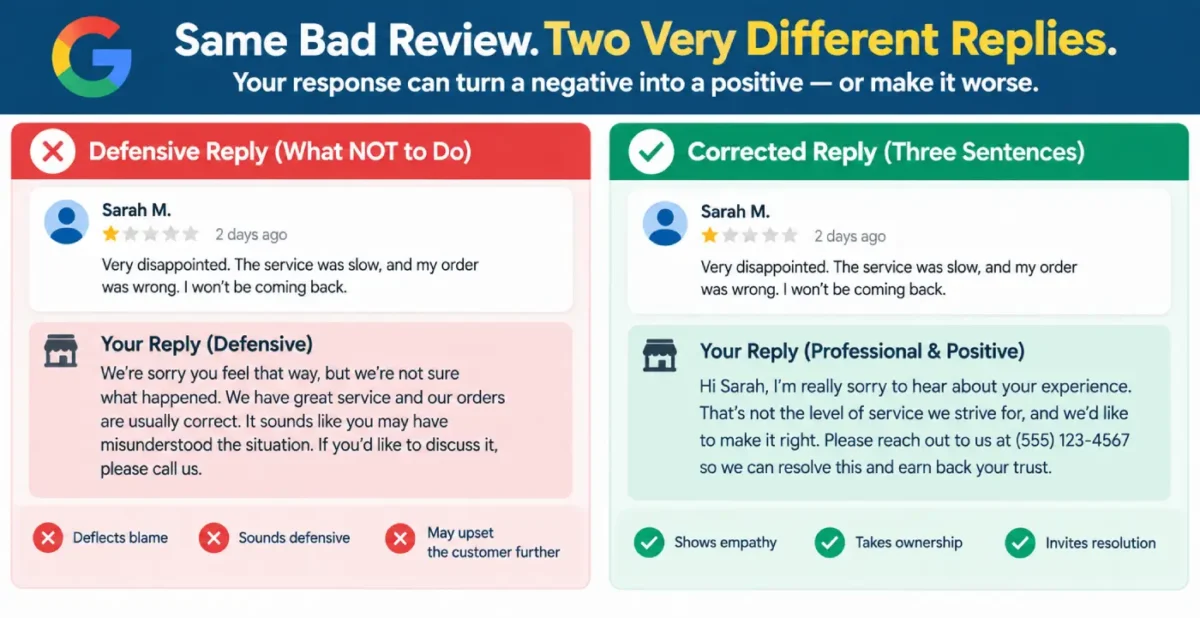
The same complaint, answered two ways. The version on the right is the one that brings in the next customer.
- The monsoon spike. Roofers, tree services, and restoration crews in Tucson take a volume hit every July and August. Jobs get rescheduled around storms, customers wait longer than they were promised, and the reviews that follow are almost all about communication rather than workmanship. Those are the most fixable negative reviews in the local market, and most of them sit unanswered.
- Snowbird season mismatch. From January through March the customer base in Green Valley, Sahuarita, and Oro Valley shifts toward seasonal residents who are comparing you against providers back home. Price complaints cluster here. So do reviews from people who will never return, which matters because you are writing for the next reader anyway.
- The nine-review profile. A newer business in Marana or Vail with nine reviews and one bad one is sitting at 4.1. The same bad review inside a 140-review profile is invisible. Volume is the structural answer, and every owner underestimates how fast the math turns.
- The eleven-reply thread. The single most common reputation problem I find on a new client’s profile is not a bad review. It is an owner who replied eleven times to the same reviewer.
One more thing before the library. You cannot buy or threaten your way out of a bad review. The FTC’s 2024 rule on consumer reviews and testimonials, effective October 2024, prohibits compensation conditioned on reviews expressing a particular sentiment and treats review suppression through unfounded legal threats or intimidation as a violation in its own right, with civil penalties per violation. Google’s prohibited and restricted content policy separately bars offering discounts or free services in exchange for removing a negative review, and bars selectively soliciting only positive ones. Every script below stays on the right side of both, which is not a legal opinion — I am not a lawyer — but it is how I write these for clients.
The three rules behind all eight scripts
Every reply in this library is built the same way, because the same structure works whether the complaint is fair or fabricated.
- Acknowledge without agreeing. “I understand this was frustrating” is not an admission. “You’re right, we dropped the ball on your install” is, and it can follow you into a small-claims hearing.
- Correct at most one fact, in one sentence. If a review contains four inaccuracies, pick the one a stranger would care about and let the other three go. Fighting all four makes the reader assume you are the problem.
- End with a named human and a direct number. Not “please contact our customer care team.” “Call me directly at 520-555-0100 and ask for David.” That single line does more for the next reader than everything above it.
Bracketed text is yours to fill in. Keep the fill-ins short and specific — specificity is what separates a real reply from a template, and readers spot the difference instantly.
1. The no-show customer who blames you
They booked a window, never answered the door, got charged a trip fee, and left two stars calling it a scam. Your records are airtight. That is exactly why this one is dangerous: a detailed public takedown of a customer reads as vindictive even when every word is true.
The goal: show the reader you have a documented process, without narrating that documentation.
Hi [First name] — I’m sorry this ended badly. Our records show a scheduled [appointment/service] on [date] with a [trip charge/deposit] policy that’s confirmed in writing when the appointment is booked, and I’d rather walk you through what happened than debate it here. Please call me directly at [phone] and ask for [name]. If we got something wrong on our end, I’ll make it right.
Script — the no-showWhat never to say:
- “You weren’t home. Our tech waited 20 minutes and called twice.” Accurate, and it reads as an argument you are determined to win.
- “You agreed to this when you signed.” Legally sound, emotionally disastrous. The reader hears a business that lawyers its customers.
- Anything that reveals their address, the time window, or what they ordered. You are publishing a customer’s private transaction on Google.
Flag it? No. A dispute over a trip fee is a legitimate customer experience, even when the customer is wrong. Google states plainly that it does not get involved in conflicts between businesses and customers.
2. The price complaint
“$450 to replace a capacitor. Total ripoff.” The work was fine. They hated the invoice. In my experience these cost more leads than any other type, because price anxiety is the one thing every reader shares.
The goal: reframe the number as a scope. You are not defending the price to the reviewer, you are telling the reader what the price bought.
Thanks for the feedback, [First name]. That visit covered [specific inclusions — the part, the diagnostic, the labor, the warranty period], and I know a single line item on an invoice doesn’t make that obvious. We quote the full cost before any work starts so nobody is surprised at the end — if that didn’t happen clearly enough on your job, that’s on us. Call me at [phone] and I’ll go through the invoice line by line.
Script — the price complaintWhat never to say:
- “Our prices are competitive for the Tucson market.” Empty, unprovable, and every reader has heard it.
- “You get what you pay for.” You have just insulted every price-conscious reader on the page.
- “Cheaper contractors cut corners.” Now you are running down competitors in public, which reads as insecurity.
- Any partial refund offered in exchange for revising the review.
Flag it? No.
3. The one-star with no text
A bare star rating. No name you recognize, nothing to respond to. Owners skip these, which is the one mistake that guarantees the rating does damage with no counterweight at all.
The goal: put a human on the record, and signal that you have no idea who this is — without saying “we have no idea who this is.”
I’d genuinely like to understand what went wrong here. There’s no detail in this rating for me to work from, and I’d rather fix a real problem than guess at one. If you were a customer of ours, please call me at [phone] — I read every one of these myself.
Script — the silent one-starThat last clause is the whole point. “If you were a customer” plants reasonable doubt without accusing anybody, and “I read every one of these myself” tells the reader the owner is present.
What never to say:
- “We have no record of you as a customer.” You cannot know that from a display name, and if you are wrong you look careless.
- “Please remove this review if you did not use our service.” Do not ask for removal in public. Ever.
- “This is clearly from a competitor.” Maybe true. Reads as paranoid.
Flag it? A no-text rating on its own is not a policy violation. Three of them in a week from accounts with no history is a pattern worth reporting as fake engagement.
4. The review from someone who was never a customer
A competitor, a disgruntled applicant, a neighbor with a parking grievance, or somebody who has you confused with a business two exits up I-10. This one you can actually get removed, which changes the whole strategy.
The goal: two separate actions. Flag it through the proper channel, and post a short, non-accusatory reply that protects you for however many weeks the review stays up.
We take every complaint seriously, so I looked into this one carefully — and I can’t match it to any job, appointment, or customer in our records. If we’ve served you under a different name, please call me at [phone] and I’ll make it right. If this was posted about a different business, I’d appreciate you taking it down.
Script — the non-customerNote the difference from Situation 3: here you are saying you checked and found nothing, which you can genuinely do. The closing line is a request about a review you believe is misdirected, not an offer or a threat.
What never to say:
- “This review is fake and we’ve reported it to Google.” Announcing the flag helps nothing and makes you look like you are working the system.
- “We know who you are.” Menacing, and it can put you in defamation territory yourself.
- Naming the competitor you suspect. Never put another business’s name in a review reply.
- Any suggestion of legal action.
Flag it? Yes. Google’s content policy bars contributions from people with no genuine experience of the business, and bars content based on a conflict of interest, which it defines to include industry competitors and current or former employment. Flag it from the profile, and if the first pass comes back with no violation found, use the one-time appeal in the Reviews Management Tool. Keep a dated note of the review text, because appeals go faster when you can state plainly what you checked.
5. The review about an employee
“The blonde girl at the front desk was incredibly rude.” You now have two audiences: the reader, and the employee who will see this before lunch. Most owners get one of the two badly wrong.
The goal: own the experience as the business, without either throwing the employee under the bus or dismissing the complaint.
Thank you for telling me — I’d rather hear this than not. How you’re treated at the front desk is my responsibility, not any one person’s, and what you’re describing isn’t the standard we hold. I’ve already talked with the team about it. If you’ll give me ten minutes on the phone at [phone], I’d like to hear the whole thing directly.
Script — the employee complaintWhat never to say:
- The employee’s name. Not to defend them, not to apologize for them. You are publishing an identifiable staff member’s worst day on a public profile, and in a market the size of Tucson that follows them.
- “That employee no longer works here.” Owners love this line. It tells the reader you fire people over Google reviews, and every future job applicant reading your profile takes note.
- “She has been with us nine years and has never had a complaint.” You have just called the customer a liar using the employee as the weapon.
- Physical descriptions of any kind, even repeating theirs.
Flag it? No, unless the review contains harassment, slurs, or identifying personal details about the employee, which do violate the content policy.
6. The accurate complaint
They are right. You missed the window, the part was wrong, the crew left a mess, the crown came off in eight months. This is the easiest reply in the library and the one owners agonize over the longest.
The goal: a clean, unhedged acknowledgment. Readers forgive mistakes. They do not forgive weaseling, and they can spot it in one sentence.
You’re right, and I’m sorry. [One sentence on what went wrong, in plain language.] We’ve changed [the specific thing] so it doesn’t happen to the next customer. I’d still like to make this right for you — call me directly at [phone].
Script — the fair hitFour sentences. No “however,” no “while we understand,” no explanation of the supply chain. I have watched replies like this pull more new customers than a page of five-star reviews, because a business that admits a specific failure and names a specific fix is the most credible thing on the page.
What never to say:
- “We apologize for any inconvenience you may have experienced.” Corporate throat-clearing. It signals that nobody read the review.
- “Unfortunately our supplier…” The reader hired you, not your supplier.
- “This is not typical of us.” Every business says this. It converts an apology into a defense.
- A discount in the public reply. Handle compensation on the phone.
Flag it? No. And do not try. An accurate complaint is the review system working.
7. The escalating replier
You wrote a good reply. They edited their review to attack it. You replied again. Now there are four rounds on your profile and the original complaint has been forgotten. Every additional round costs you more than the original one-star did.
The goal: close the thread with dignity, then stop permanently.
I don’t think we’re going to agree on what happened, and I’m not going to keep going back and forth in public — it doesn’t serve you or anybody else reading. My offer stands: call me at [phone] and I’ll listen to the whole thing. I’ll leave it there.
Script — the last wordThen actually stop. If they post six more edits, you post nothing. “I’ll leave it there” only works if you mean it, and readers reward the person who walked away.
What never to say:
- “As I already explained…” and “For the third time…” Both announce that you are losing.
- Timestamps, call logs, screenshots, invoice numbers. Evidence dumps make the reader assume there is more to the story.
- Anything about their character, tone, or mental state.
- “We are done here.” Correct instinct, hostile phrasing.
Flag it? Only if the escalation crosses into harassment, profanity, or personal attacks on named staff. Rudeness by itself is not a violation.
8. The review that is actually a refund request
“Still waiting on my $280 back. Two weeks and no call. One star until this is resolved.” This is not a review. It is a support ticket filed in the wrong place, and it is the most fixable item on this list — in my experience these reviewers revise or delete more often than any other type, because they were never trying to hurt you. They were trying to get somebody’s attention.
The goal: move fast, commit to a date in public, and do not mention the review or ask for anything.
[First name] — I’ve got this. I’m pulling your file this morning and you’ll hear from me by [specific day] with either the refund processed or an exact date it will be. You shouldn’t have had to come here to get an answer, and I’m sorry you did. My direct line is [phone].
Script — the refund requestThen hit the date. Do not ask them to update the review, before or after. If you resolve it well, most people update on their own, and the ones who do not have still left a public record of a business that fixed the problem in two days.
What never to say:
- “Once this is resolved, would you consider updating your review?” This is the trap. Conditioning a resolution on review revision is the exact practice the FTC rule targets, and Google’s policy prohibits it too.
- “Refunds take 7–10 business days per our policy.” True, and it reads as a stall.
- “We’ve tried to reach you three times.” Maybe. Still an argument.
The whole library on one screen
| Situation | What the reply is actually doing | Flag it? | Reply again if they respond? |
|---|---|---|---|
| No-show customer | Showing a documented process without reciting it | No | No |
| Price complaint | Turning a number into a scope for the next reader | No | No |
| One-star, no text | Putting a human on the record beside a bare rating | Only if part of a pattern | No |
| Never a customer | Holding the line while the flag is reviewed | Yes — plus appeal | No |
| About an employee | Absorbing the complaint at the owner level | Only if it names or attacks staff | No |
| Accurate complaint | Buying credibility with a specific admission | No | Once, if they thank you |
| Escalating replier | Closing the thread in front of witnesses | Only if abusive | Never |
| Refund request | Committing to a date in public | No | Yes, to confirm it is done |
The mechanics: where, when, and how long
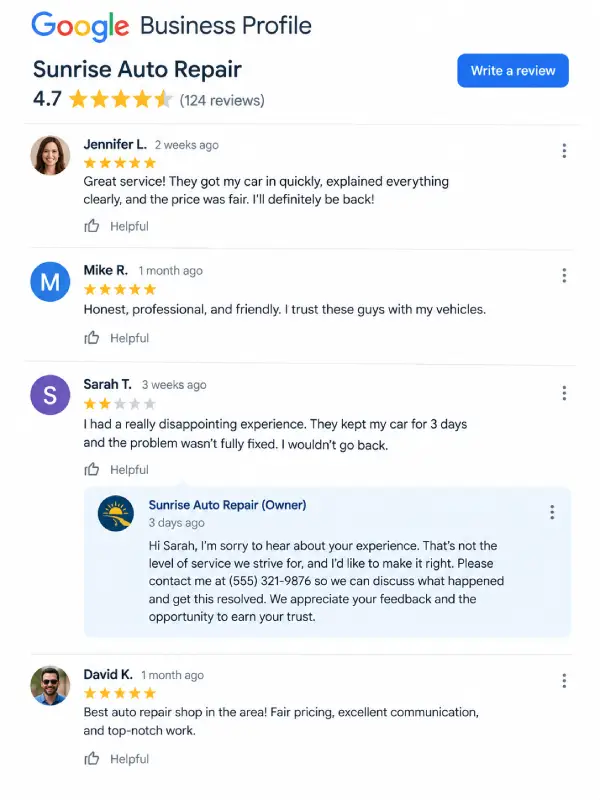
Where. You reply from your verified Business Profile — open the profile, choose Read reviews, then Reply next to the review. Google requires verification before you can reply at all and documents the steps here. One person in the business should own this. Two people replying independently is how you end up with a duplicate response and a contradiction.
When. Within 24 hours, and not within 24 minutes. The reply you write while the adrenaline is up is the reply you regret. Read it, close the tab, write it an hour later. If it is a fair complaint, faster is better. If it makes you furious, sleep on it — nobody has ever been hurt by replying on day two.
How long. Three to five sentences. In thirty-five years I have never seen a reply over 120 words help a business. Length reads as guilt. If you need more room, the conversation belongs on the phone, which is the purpose of the last line in every script above.
One profile, one voice
Whoever writes these replies is writing public-facing brand copy under pressure. If that is not a job you want, it is part of what I do for every client — review monitoring, response drafting, and profile management are included in the flat $1,000 monthly fee, month to month, not sold as an add-on. Profile audits are free, and the person who answers the phone is the person who does the work.
When a review can actually come down
Owners waste enormous energy chasing removals that were never going to happen. Google removes reviews that violate its content policies — not reviews that are unfair, wrong, exaggerated, or written by somebody having a bad day.
A review is potentially removable when it contains hate speech, harassment, profanity, or sexually explicit content; when it is off-topic or about a different business; when it comes from someone with no genuine experience of your business; when it reflects a conflict of interest such as a competitor or former employee; or when it is part of a coordinated pattern. Google also treats extortion attempts involving negative reviews as a separate reportable incident. The reporting path and the one-time appeal are in Google’s guidance on reporting inappropriate reviews, and the full prohibited list is in the Maps user-generated content policy.
Two practical notes from doing this for years. Flag once and wait — repeatedly reporting the same review does not speed anything up. And keep replying while you wait. A flagged review that sits unanswered for three weeks did all its damage before Google ever looked at it.
The real fix is volume
Every script on this page is damage control. The structural answer to negative reviews is a steady flow of honest ones, so a bad month is arithmetically irrelevant. A business with 140 reviews at 4.7 absorbs a one-star without flinching. A business with nine at 4.1 does not.
That means asking every customer, every time, without conditions and without incentives. Asking only your happy customers is itself a policy violation, and offering anything of value for a review breaks both Google’s rules and the FTC rule. Ask everyone, honestly, and let the average take care of itself. Review velocity is one of the signals I work on directly alongside the profile, the citations, the technical foundation, and the three to ten pages of new local content I write for every client each month — the full picture is on my Tucson local SEO services page, and if you just want somebody to look at your profile and tell you the truth about it, that consultation is free.
What clients say
I hold my own profile to everything on this page. These are verbatim Google reviews from clients of my practice under its former name, Temecula SEO, before the 2022 move to Tucson.
David built and developed the website for my business. His customer service and expertise are superior to anyone else I had previously used. How many web development guys had I been through that promise the moon, work hard for a short while, then become difficult to get a hold of later? I’ll tell you: there were 9 in 7 years! … If you want an SEO guy you can count on, David with Temecula SEO is your man!
Leo Rich Severns Master Technician · 5.0 Google review, Temecula SEOWe have worked with David for over a year now and he is great to work with. David has built us a great new website that we love and our Google ranking has improved significantly. David is a great guy and works day and night to help you. I highly recommend Temecula seo. Thank you David for your hard work.
Jason Moat 5.0 Google review, Temecula SEOI made a decision to Hire David, with Temecula SEO about a year ago now, it has changed the presence of my company online greatly. I would highly recommend giving david a chance if you are looking for an honest SEO company.
Jordan Johnson 5.0 Google review, Temecula SEODavid is great to work with. He takes his job seriously, is a wealth of knowledge not only in SEO, but also business in general. If you are looking to for someone to handle SEO for you — you can stop looking now.
Russ Colburn 5.0 Google review, Temecula SEOFrequently asked questions
Should I respond to a bad review if it is more than a year old?
Yes, if it still has no reply. Readers do not check dates as carefully as owners assume, and an unanswered complaint reads as current. Keep the wording present-tense and brief, and do not draw attention to the delay — no “I just saw this.” If the issue was resolved at the time, one sentence saying so is enough.
Can I use AI to write my review responses?
For a first draft, yes. To post unedited, no. Consumers have gotten very good at spotting generic replies, and a visibly templated response to a serious complaint does more harm than no response at all. Use a draft as a starting point, then add the one specific detail only you know — the service, the date, the fix — and put a real name and direct number at the end.
What if the review contains private customer information, like a medical or financial detail?
Do not repeat any of it in your reply, not even to correct it, and be especially careful if you are in a regulated field — confirming that someone was a patient or a client can itself be a disclosure problem. Reply generically, invite the conversation offline, and report the review if the personal information belongs to a third party such as an employee.
Is it worth replying to a one-star review on a platform nobody uses?
Reply if the platform shows up when someone searches your business name. That is the only test that matters. Consumers now check several sources before choosing a local business, and a neglected profile on a minor directory can still surface in branded search results or get pulled into an AI-generated summary of your business.
Should I ask a customer to take down a review after I fix the problem?
Resolve the problem and say nothing about the review. Asking is legally risky the moment anything of value is attached to it, and even a clean request tends to backfire — people who feel managed write worse second reviews. Fix it, hit the date you promised, and let them decide.
How many negative reviews is too many?
There is no threshold number, only a ratio and a trend. A handful of ones and twos inside a large, steadily growing profile is normal and arguably makes the good reviews more believable. The warning sign is a cluster of negatives about the same specific failure, which tells you and every reader that the problem is the process, not the customer.
About the author. David Cragg has worked in search marketing since 1990 — three years before the first mainstream web browser and eight before Google launched — including Fortune 100 engagements, and founded and sold two internet marketing companies, one funded by IBM and one sponsored by Microsoft. He now runs Tucson SEO, an intentionally small practice serving Tucson, Oro Valley, Marana, Sahuarita, Green Valley, Vail, and Catalina, where he writes the copy, builds the schema, and edits the CSS himself. One client relationship has run more than ten years. The wording on this page comes from replies written on live client profiles, not from a template library.
Nothing here is legal advice. For a dispute involving defamation or a threatened claim, talk to an attorney licensed in Arizona.
AI tools were used to assist in researching and drafting portions of this article. All guidance, wording, and editorial judgment are the author’s own, based on direct client work.