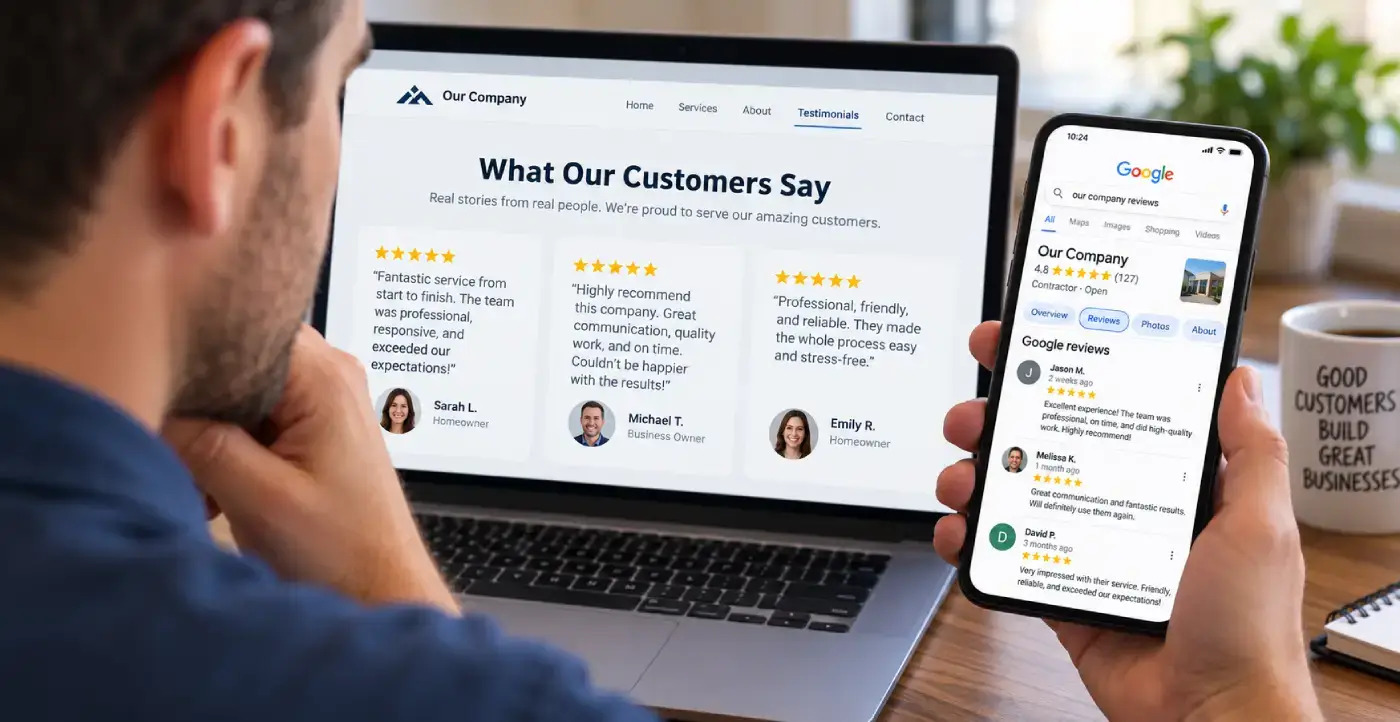
Why Don't Your Website's Testimonials Show Review Stars in Google Search Results?
Because the reviews are about you and they're on your own site. Google stopped showing stars for that in 2019, and no plugin, widget or markup changes it.
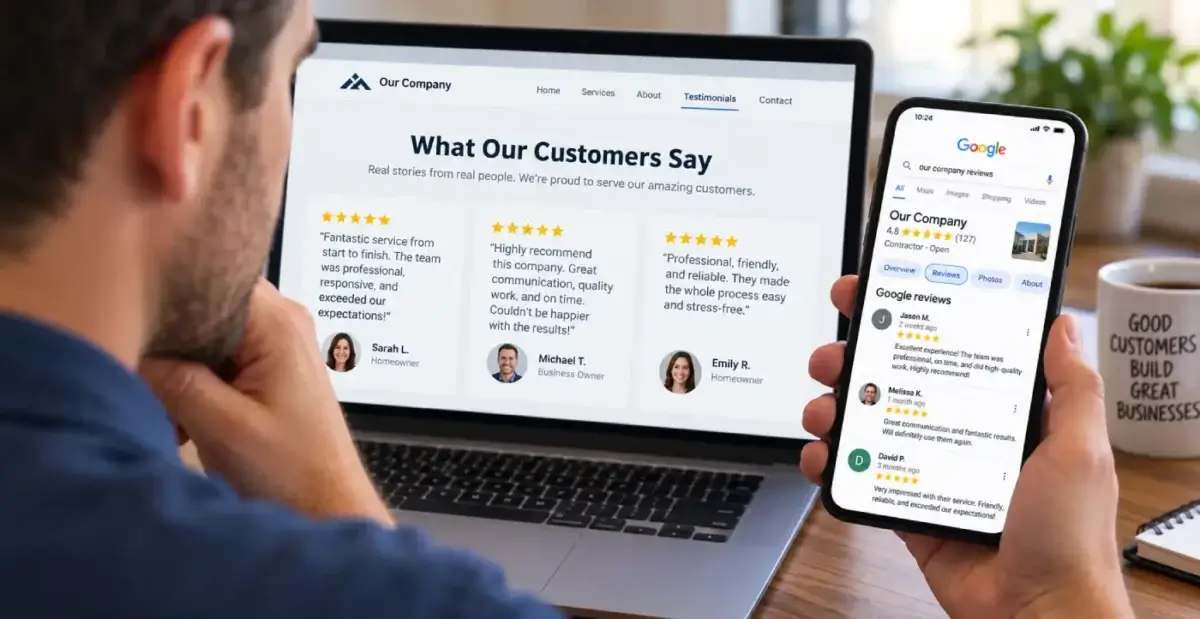
I'm David Cragg. I write the structured data for the sites I manage by hand, and I check it against the live page source rather than trusting what a plugin says it's doing. The question in the title comes up on almost every first call with a new client: "We have two hundred reviews on our site, so why don't we get review stars in Google search results?" This page explains Google's rule, what happens if you mark up your own reviews anyway, and what compliant markup for testimonials looks like. You can see the compliant version on this page. The four client reviews further down are plain HTML, with no review markup behind them.
This page is only about whether reviews on your own website can earn stars in regular search results. For structured data in general, see my technical SEO service. The stars next to your name on Google Maps come from your Business Profile, not your website, and the place to start with those is how to get more Google reviews.
The eligibility rules here come from Google's own documentation, linked at the bottom. The audit steps and what I find on client sites are my practice, and I've said so where it matters.
The short version
- Self-serving reviews don't get stars. That's Google's term for reviews of a business that the business displays on its own site, marked up as LocalBusiness or Organization.
- Widgets don't get around it. Google treats an embedded third-party review widget as the business controlling which reviews appear.
- The markup isn't a penalty by itself, but it can lead to one. Google's review snippet guidelines carry a manual-action warning, and since July 24, 2026 they also prohibit fake and undisclosed incentivized reviews on the page or in the markup.
- Products still qualify. Reviews of a product you sell, written by customers and shown on that product's page, remain eligible.
- Testimonials still work without stars. Show them as honest, attributed text and let them do their real job, which is persuading the person reading the page.
What Exactly Is Google's Rule on Self-Serving Reviews?
Google announced it in September 2019 on its Search Central blog, and the rule is still in the review snippet documentation today. A review is self-serving when a business places reviews about itself on its own website. For pages using the LocalBusiness or Organization structured data types, Google won't show stars for those reviews. The 2019 announcement was direct about widgets too. Embedding a third-party widget counts as controlling the reviews, so a review badge from a reputation platform on your homepage is treated the same as reviews you typed in yourself.
The reasoning makes sense from the searcher's side. A business chooses which reviews appear on its own site. Stars built from that selection tell a searcher very little. Stars from a site that collects reviews about many businesses tell them something.
The current documentation adds two rules that catch local businesses. Ratings have to come directly from users, and a site can't have editors create, curate or compile ratings for local businesses. And you can't aggregate reviews or ratings from other websites into your markup. Copying your Google rating into your own AggregateRating doesn't qualify either.
Where Do the Stars You See Next to Businesses Actually Come From?
Owners see review stars in Google search results next to a competitor and assume the competitor found a markup trick. They almost never did. Stars in Google come from a handful of places, and only one of them involves code on your own website.
| Where the stars show | Where they come from | Can your website change them? |
|---|---|---|
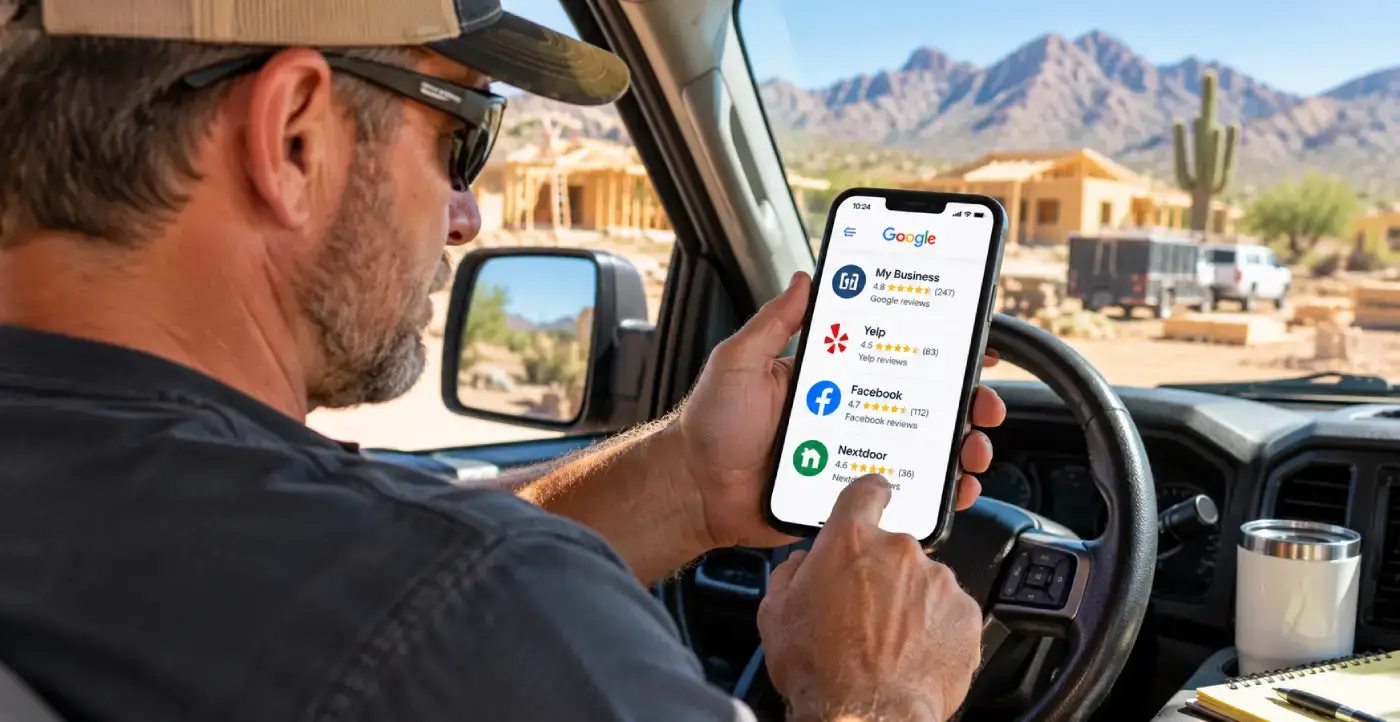
| Google Maps and the local pack | Reviews on your Google Business Profile | No. They come from your profile. |
| A review site's page about you, such as Yelp or BBB, in regular results | That site's own markup for the businesses it reviews | No. The review site controls them. |
| Product pages in regular results | Product markup with customer reviews of that specific product | Yes, if you sell products and collect genuine reviews of them. |
| Google Ads | Seller ratings and other ad review sources, which are a separate system | Not through markup on your site. |
| Your homepage or service pages | Nothing. Reviews of your own business on your own site are self-serving. | No. |
The product row is the only one your own markup can earn. If you're a plumber, an accountant or a dentist, you probably don't have product pages, and that's fine. It means the stars you're after live on your profile and on review sites, not in your code.
Which Kinds of Pages Can Still Earn Review Stars?
Google lists the features that support review snippets: Book, Course list, Event, Local business, Movie, Product, Recipe and Software App. It also supports reviews for a few other types, including Game, MediaObject, MusicRecording and Organization. Service isn't on the list. A page about your roof repair or your tax preparation doesn't become eligible by calling itself a Product.
Local business and Organization appear on that list, which confuses people. They're eligible on sites that collect reviews about other businesses, like a directory where customers review plumbers. A plumber's own site reviewing itself is the case Google excludes.
The honest exception for local businesses is retail. Say you sell and install a particular water filtration system. Reviews of that system from customers who bought it, shown on that product's page and marked up as Product, can qualify. Reviews of your installation service can't be relabeled as product reviews to get there.
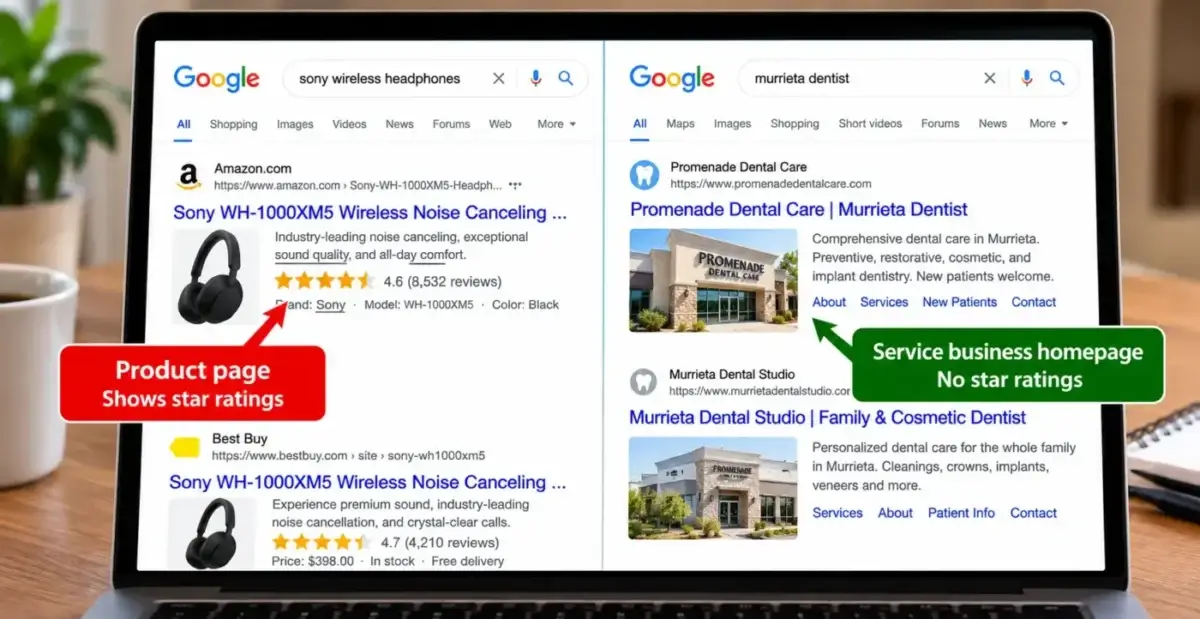
Stars still appear under product pages with genuine product reviews. A service business's own homepage doesn't qualify, however many testimonials it shows.
What Happens If You Mark Up Your Own Testimonials Anyway?
In the best case, nothing. Google ignores the markup, and you've spent time on code that does no work. When Google announced the rule in 2019, it said self-serving markup on its own wouldn't bring a manual action. Most sites don't stop there, though.
The risk is in the guidelines around it. Google's review snippet documentation warns that sites violating its guidelines may receive a manual action. Those guidelines include rules that self-serving markup tends to break: the reviews must be visible on the page that's marked up, ratings must come from real users, and reviews from other websites can't be aggregated. On July 24, 2026, Google added one more. Don't include fake reviews, or reviews given in exchange for money, discounts or free products without a clear disclosure, either on the page or in the markup.
A structured data manual action means Google ignores the structured data on the affected pages. The pages stay in search, but you lose rich results you might otherwise qualify for, and you get a notice in Search Console that has to be fixed and submitted for reconsideration. For a local business, that's an avoidable mess over stars that were never going to appear.
How do you check whether your site already has this problem?
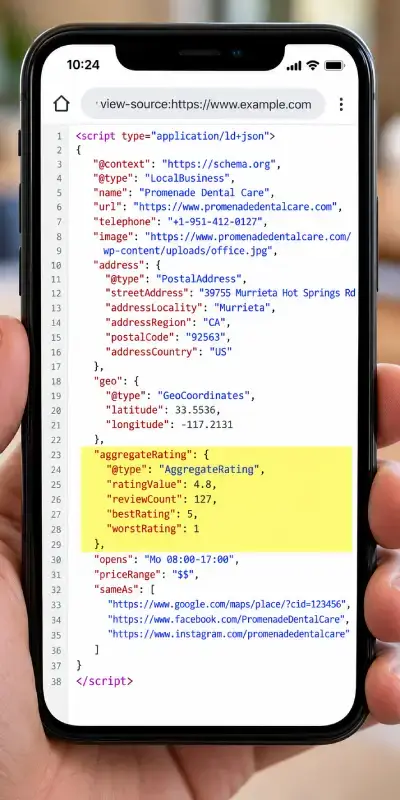
Plugin settings don't always show what the plugin outputs. The live page source does.
Most of the self-serving markup I find was never written on purpose. A review plugin, a theme's testimonial block or an SEO plugin's schema setting added it quietly. This is how I check, and it's my routine rather than a Google procedure:
- Read the live page source, not the plugin's settings screen. Search the source for "AggregateRating" and "reviewRating." If they sit inside LocalBusiness or Organization markup on your own site, that's self-serving markup.
- Run the page through the Rich Results Test. It shows what Google can read. It can't tell whether the reviews are self-serving, so a passing result doesn't settle the question.
- Open the Manual actions report in Search Console. If anything is listed under structured data, fix the markup before anything else.
- Check every template, not just the homepage. Review widgets often inject markup on every page where the widget appears, including blog posts and location pages.
What Does Compliant Markup for Testimonials Look Like?
Two patterns cover nearly every local business. Use the one that matches what you sell.
What should a service business do?
Mark up the business, not the reviews. Your LocalBusiness or Organization markup should describe who you are and point to the profiles where your reviews actually live, using the sameAs property. Customers and search engines can follow those links to the real ratings. Then show your testimonials on the page as plain text. This is the pattern to remove:
{
  "@type": "LocalBusiness",
  "name": "Example Plumbing",
  "aggregateRating": {
    "@type": "AggregateRating",
    "ratingValue": "4.9",
    "reviewCount": "212"
  }
}
And this is the pattern to use instead. It names the business, gives it a stable identifier, and links the profiles where customers review it:
{
  "@type": "LocalBusiness",
  "@id": "https://example.com/#business",
  "name": "Example Plumbing",
  "url": "https://example.com/",
  "telephone": "+15205550100",
  "sameAs": [
    "https://www.google.com/maps?cid=YOUR-PROFILE-CID",
    "https://www.yelp.com/biz/example-plumbing-tucson",
    "https://www.bbb.org/us/az/tucson/profile/plumber/example-plumbing"
  ]
}
What should a business that sells products do?
Put Product markup on each product page, with Review or AggregateRating for that product only, built from reviews customers left about that product and shown on the same page. Keep business-level testimonials out of those pages' markup. If any of the reviews came from customers who received a discount or a free sample, say so clearly next to the review.
How should the visible testimonials be written?
Without stars, a testimonial's only job is to be believed. Quote it in full, use the reviewer's name as it appears on the original platform, and say where it was left. Don't trim the critical sentence out of a mixed review, and don't present a review of an earlier version of your business as a review of today's. The FTC's rule on consumer reviews and testimonials covers reviews that misrepresent the reviewer's experience. My reputation management service page covers what that rule means for how you collect reviews. The point here is simpler: an honest testimonial block is also the compliant one.
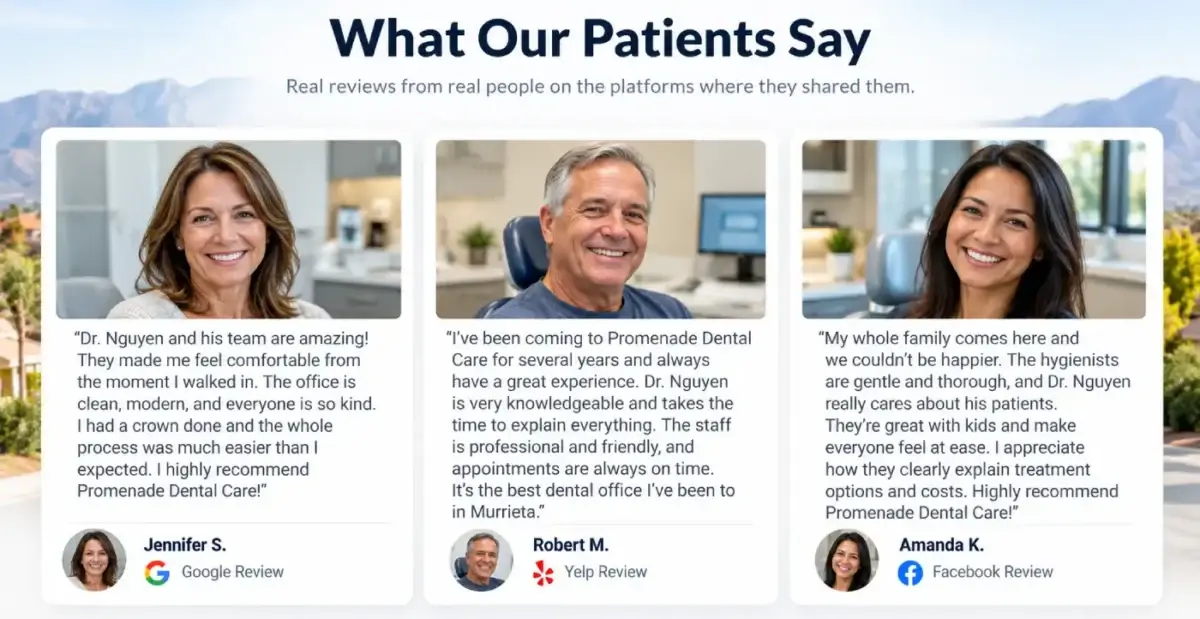
A compliant testimonial block: the full review, the reviewer's name as it appears on the platform, and where it was left. No stars required.
Can a Local Business Get Review Stars in Google Search Results Any Other Way?
Yes, just not from its own website. Customers who search your name typically see stars in three places, and all three are earned somewhere else.
- Your Google Business Profile, which shows your rating in Maps and the local pack. That rating comes from reviews customers leave on the profile.
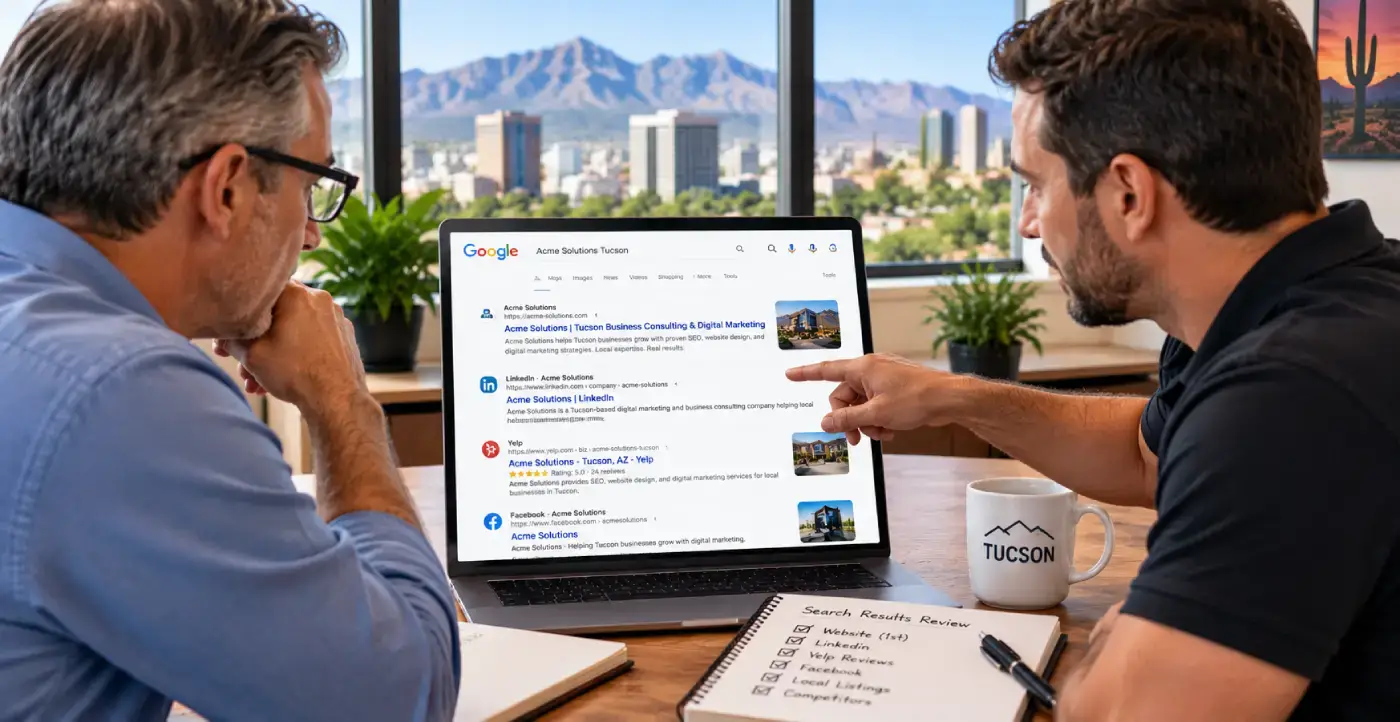
- Review sites that rank for "[your name] reviews." A Yelp or BBB page about you often shows its own stars in regular results. Which ones matter for your industry is covered in which review sites for small business are worth your time.
- Product pages, if you sell products, as described above.
Do Review Stars Matter for AI Search?
Less than people assume. AI Overviews and assistants like ChatGPT read the visible text of a page, and when someone asks whether a business is any good, they tend to lean on what other sites say about it. Review markup on your own site isn't a shortcut into those answers. What helps is the same thing that helps a human reader: real, attributed testimonials on the page, and real reviews on the sites AI tools cite. How AI tools build answers about local businesses is covered in improving AI search visibility.
Is Your Site Carrying Review Markup It Shouldn't?
Send me your URL. I'll read the live page source on your homepage and a few templates, find any plugin-injected AggregateRating, and tell you exactly what to remove and what to keep. The first look is free and there's nothing to sign.
Ask David to check your markup
Or call (520) 207-6000. You get me, not an account manager.
What's Different About This in Tucson?
The rule is the same everywhere. Three local situations make it easier to get wrong here.
Plenty of Tucson service businesses also sell products. Hard water is a fact of life here, so a lot of local plumbers sell softeners and filters, pool companies sell equipment, and HVAC shops sell specific units. Those product pages can earn stars with genuine product reviews. The service pages next to them can't. The temptation is to blur the two by putting service testimonials into Product markup, and that's exactly the kind of misrepresentation the guidelines warn about.
Spanish-language reviews deserve to be quoted as written. Many Tucson businesses have customers who review them in Spanish. Quote the review in Spanish exactly as it was left, and if you add an English translation, label it as yours. Rewriting it in English as though the customer said it that way is the kind of edit that turns an honest testimonial into a misleading one.
Businesses that moved here bring reviews from somewhere else. I did. Most of my own reviews were left on the Temecula SEO profile before I moved the practice to Tucson in 2022, and every one on this site says so. If your reviews were earned in another city or under another name, label them that way. What happens to your Google reviews after a rebrand or move covers how.
Would You Rather Not Do This Yourself?
Schema cleanup is part of ordinary technical SEO for my clients, and it's included in the fee rather than billed as a project. It usually travels with other work. The stars that do show next to your name come through Google Business Profile management and reputation management. A testimonials section that needs rebuilding as honest text is website design work, and if you want the full list of what your site's markup is doing before you spend anything, start with an SEO audit.
It's all inside the same $1,000 a month, no contract. I work across Oro Valley, Marana, Catalina Foothills, Sahuarita, Green Valley and Vail, and I take one client per competitive niche per zone. Here's why people work with me, and here's the background you can go check.
What Do Clients Say About Working With David?
Four of the ten reviews on my Google profiles, quoted in full, as plain text with no review markup. Two were left under the SEO Tucson name. The others were left on the Temecula SEO profile during the Southern California years, before the practice moved to Tucson in 2022.
David has been a huge help to my business. He's knowledgeable, responsive, and consistently delivers great work. Since working with him, we've seen strong improvements and he continues to go above and beyond to help our business grow. Highly recommend David and SEO Tucson to anyone looking for someone who truly cares about getting results.
Weston Molitor Wild West Junk Removal · SEO Tucson
If you are looking for help with SEO, or anything related, David is your man! I talked to several other companies before talking to David, and I knew right away he was different. He is extremely professional, responsive, affordable, and effective. Most importantly, I trust that he is looking out for my best interest. He takes a very hands-on approach and always takes the time to listen to the changing needs of my professional business. His wealth of knowledge is invaluable. He had my business seeing results almost immediately. Thank you David for all your hard work! Best in the business!
Luke Hendrix Temecula SEO
I made a decision to Hire David, with Temecula SEO about a year ago now, it has changed the presence of my company online greatly. I would highly recommend giving david a chance if you are looking for an honest SEO company.
Jordan Johnson Temecula SEO
I have been a client of David at SEO Tucson for over 10 years. His wealth of knowledge of SEO marketing has been a tremendous help for my company. He's always up to date with all the new rules and changes and always willing to try new things to help push and keep my company on the top of Google listing
Bao Nguyen Promenade Dental Care · SEO Tucson
What Do People Ask About Review Stars in Google?
Why did the review stars on my website disappear from Google?
Most likely because of Google's 2019 change. Reviews of a business shown on that business's own site and marked up as LocalBusiness or Organization stopped getting stars. If your stars disappeared more recently, check the Manual actions report in Search Console and confirm the marked-up reviews are still visible on the page.
Can a third-party review widget get stars on my own site?
No. Google treats an embedded widget as the business controlling which reviews appear, so widget reviews about your business are self-serving. The widget can still be useful to visitors, but it won't produce stars in search results.
Will I get a penalty for having review markup on my homepage?
Self-serving markup on its own isn't penalized. Google said in 2019 that it simply won't show the stars. A manual action becomes possible when the markup also breaks other review snippet guidelines, such as marking up reviews that aren't visible on the page, aggregating ratings from other sites, or including fake or undisclosed incentivized reviews.
Should I remove self-serving review markup from my site?
I recommend it. It does no work, it misleads anyone who audits your site, and it's one more thing that can drift out of line with Google's guidelines when a plugin updates. Keep the testimonials as visible text and remove the review properties from the markup.
Does the Rich Results Test show whether my stars will appear?
No. It shows whether Google can read the markup and whether the markup is technically valid for a feature. It can't tell whether the reviews are self-serving, so a page can pass the test and still never show stars.
Can a service business ever get review stars in regular search results?
Not for its own services on its own website. Service isn't a supported review snippet type, and reviews of the business itself are self-serving. A service business that also sells specific products can earn stars on those product pages with genuine reviews of the products.
Where do the stars next to my business on Google Maps come from?
From reviews left on your Google Business Profile. They have nothing to do with markup on your website, and adding schema to your site won't change them.
Are testimonials on my website still worth having without stars?
Yes. Stars in search results were only ever a way to win the click. Once someone is on your site, a specific, attributed testimonial from a real customer still does the persuading, and AI tools that read the page can see it too.
Can I mark up reviews of other businesses on my site?
Yes, if your site genuinely collects reviews from users about other businesses, like a directory. That's the situation LocalBusiness and Organization review markup is meant for. The ratings must come directly from users rather than from editors.
Where Does the Information on This Page Come From?
Everything on this page about eligibility comes from Google's and the FTC's own documentation. Where I'm describing what I find on client sites, the text says so. If a linked page disagrees with anything here, the linked page is the authority.
- Google Search Central: Review snippet structured data — supported types, the self-serving rule, the July 2026 guideline on fake and incentivized reviews, and the manual-action warning.
- Google Search Central Blog: Making review rich results more helpful — the September 2019 announcement, including the note on widgets.
- Search Console Help: Manual actions report — how to check for and fix a structured data manual action.
- Google Rich Results Test — what Google can parse from a page, and what it can't judge.
- Federal Trade Commission: Consumer Reviews and Testimonials Rule, questions and answers — using reviews honestly.
Want Me to Read Your Page Source and Tell You What's There?
Most owners have never seen the markup their own site outputs. I'll look at the live source, not the plugin settings, and tell you whether you're carrying self-serving review markup, where it's coming from, and what compliant markup for your business should say instead. If it's a two-minute plugin setting, I'll say so.
Or call (520) 207-6000 and I'll pull up your source while we talk.
SEO Tucson, formerly Temecula SEO
Serving Tucson and Southern Arizona
Phone: (520) 207-6000
Consultant: David Cragg, in search since 1990
Written by David Cragg, Tucson SEO consultant, in search since 1990. I write the schema on the sites I manage by hand and check it in the live source, which is where I find most of the review markup described on this page.
On how this site is written: I use AI tools to draft and to check my own work. AI does not supply the facts about your business, it does not invent sources, and nothing goes up here that I have not read first. If you find a claim on this site you can't verify, call me and I'll fix it or pull it.
Page last reviewed October 26, 2026 by David Cragg. Google updates its structured data documentation several times a year; the linked documentation is the authority if it disagrees with this page.