“I Rank #1 at My Shop and Nowhere Else.”
Maps rank is a grid, not a list. Here is how to check your position from more than one point, what a normal fade looks like, and which of Google’s three local factors a fade actually indicts.
Home › Blog › Map Pack rank is a grid
By David Cragg, SEO consultant at Tucson SEO. In search since 1990. Last reviewed September 20, 2026.
I get this call four or five times a year, and it always arrives in the same shape. The owner is standing in his own shop. He searches his main service on his phone, sees himself first, feels fine for about a day, and then a customer in another part of town tells him she couldn’t find him at all. So he checks from her side of the city and he is nowhere. Then he calls me and says some version of the same sentence: I rank number one at my shop and nowhere else. Something is broken.
Usually nothing is broken. What has happened is that he measured a grid with a ruler built for a list, and the number he got back was true and useless at the same time.
The short version
- A Map Pack position is not a property of your business. It is the answer to a question that includes a location, so it changes street by street.
- Ranking first at your own address and fourth two miles out is not a symptom. For most businesses it is the expected shape.
- Your rank at your own pin tests relevance. The radius of your green tests prominence. The direction of your dead zones tests competitive geography. Distance is the ruler, not the disease.
- You can check this free in about ten minutes with Chrome’s developer tools. A paid grid tool is faster and repeatable, not more true.
- The only comparison worth acting on is your fade against a real competitor’s fade, same grid, same keyword, same day.
What a Maps Position Actually Is
When your website ranks fourth for a phrase, that fourth is close to a fact about the page. Two people searching the same term in the same country see something close to the same order.
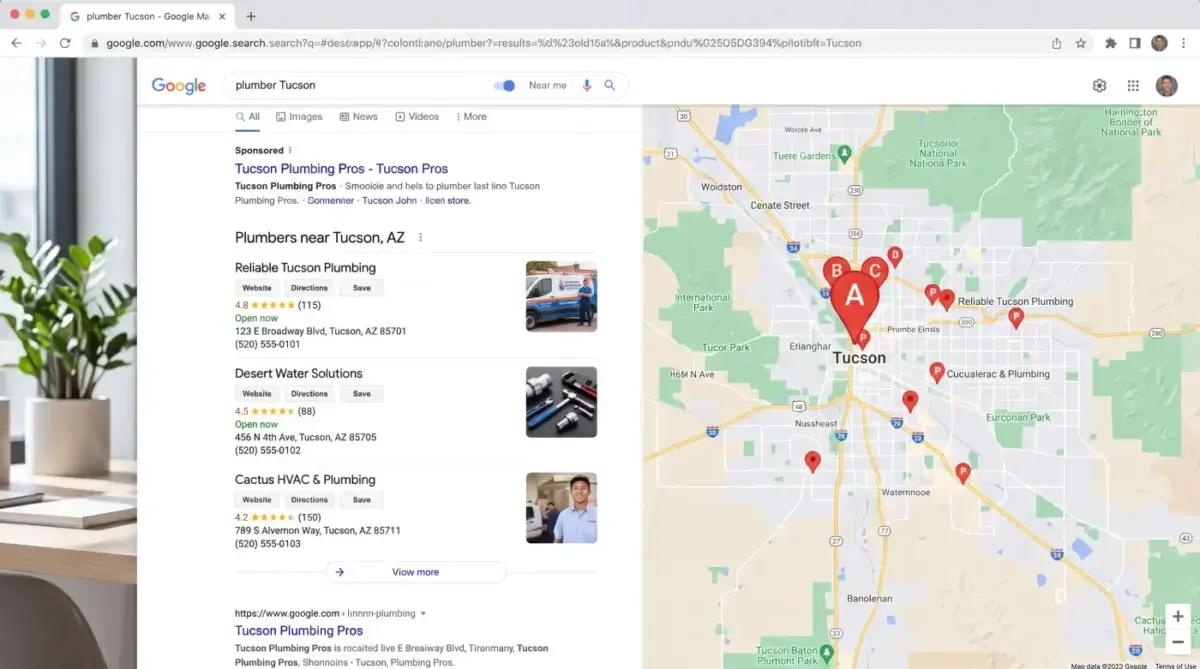
Maps does not work that way. Every Map Pack result is computed for a query and a point on the earth. Google publishes the reason and does not hide it: local results are ranked on relevance, distance, and prominence, and distance is measured from wherever the person searching happens to be. If Google does not know where they are, it works from whatever it can infer.
So “where do I rank” is an incomplete question. It is like asking who the nearest plumber is without saying where you are standing. The honest answer is a map, not a number.
Which means the owner in my opening example did not discover a problem. He ran one test, from the single most flattering location on earth for his business — his own doorstep — and then ran a second test from a location that was supposed to look worse. Both results were correct. Neither one told him anything until he put them side by side and looked at the shape between them.
Why It Has To Be a Grid
Once you accept that position is tied to a point, the measurement follows. You cannot sample one point and describe a surface. You need a spread of points and you need to look at the pattern they make.
That is the whole idea behind grid rank tracking, sometimes called a geogrid. The tool runs the same search from dozens of coordinates laid out in a square around your business and records where you placed at each one. BrightLocal’s comparison of the major grid tools is a fair survey of what is on the market; Local Falcon was the first one most of us used and is still the reference point. The output is a heat map. Green where you are in the pack, yellow where you are slipping, red where you are gone.
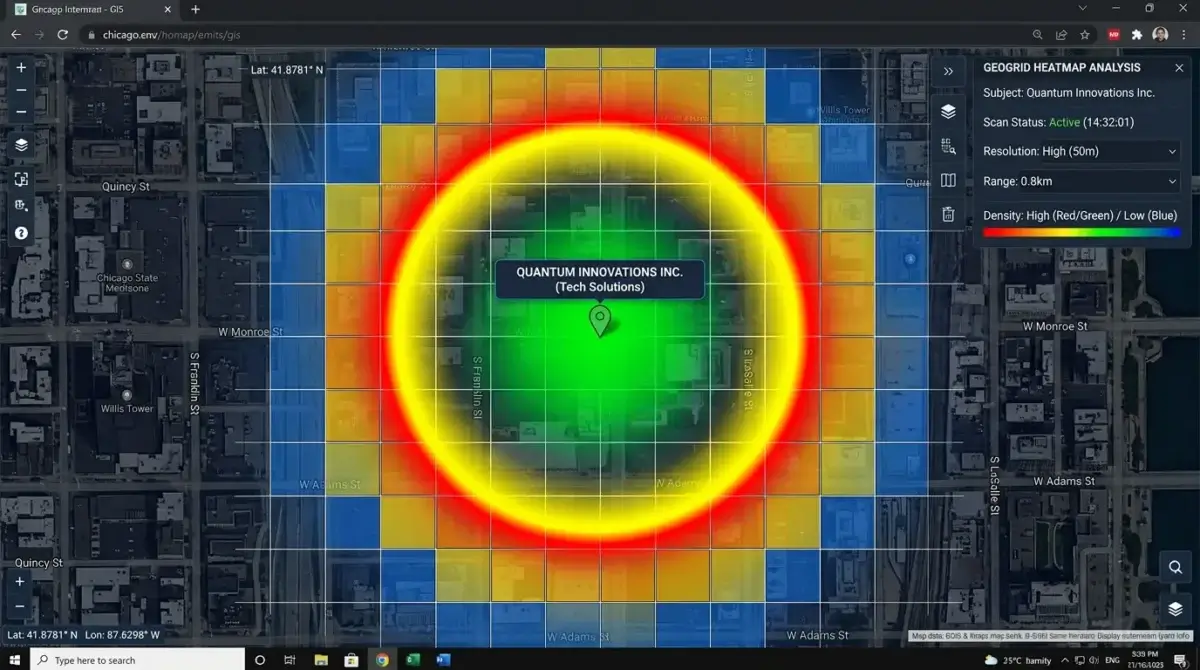
I want to be careful here, because the tools have gotten very good at producing a confident-looking picture, and a confident-looking picture of the wrong thing is worse than no picture. A grid is a measuring instrument. It tells you the shape of your visibility. It does not tell you what caused the shape. That part is judgment, and most of the rest of this page is about how I do it.
Single-point rank checks are not wrong. They are just too small a sample to argue with.
David Cragg Tucson SEO consultant, in search since 1990Checking Your Position From Another Point, Free
Before you buy anything, do this. It takes about ten minutes and it is the same method I use when a client calls and I want an answer before the call ends.
Chrome will let you tell the browser it is somewhere else. This is a documented developer feature, not a trick, and Google publishes the instructions for overriding geolocation in the Sensors panel and for saving your own locations as presets.
- Get your coordinates. Open Google Maps, right-click the spot you want to search from, and copy the latitude and longitude it shows you. Do this for five or six places: your own address, and four or five real spots where your customers live or work.
- Open a fresh Chrome window, signed out of Google, in a new incognito window. You are trying to see what a stranger sees, not what Google has learned about you.
- Open developer tools and bring up the Sensors panel from the command menu. Set Geolocation to Custom location and paste in the first coordinate pair.
- Search your money term on Google Maps. Not your business name. The thing a customer types when they do not know you exist yet: “emergency plumber,” “cosmetic dentist,” “hot tub removal.”
- Write down the position, and write down who is above you. The names above you matter more than your own number, and almost nobody records them.
- Change the coordinate and repeat. Same window, same term, new point.
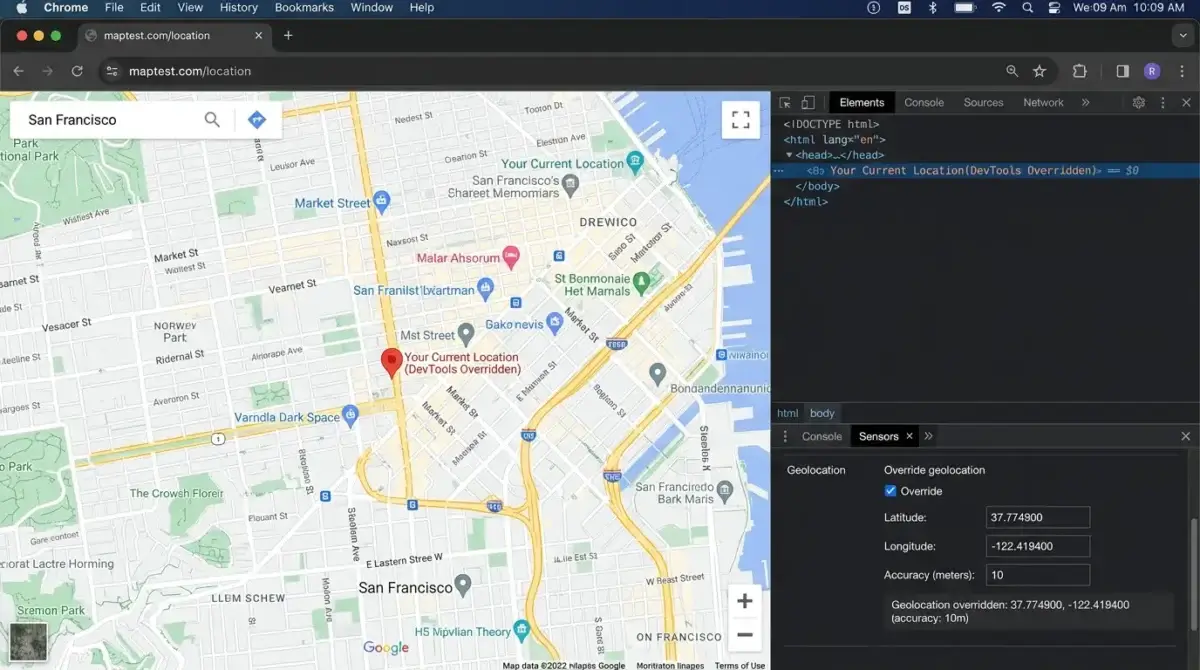
Six points is not a grid. It will not give you a defensible number to put in a report. But it will answer the only question you actually have on day one, which is whether the fade starts at half a mile or at six miles, and whether the same competitor is sitting on top of you everywhere or a different one in every direction.
Running a Real Grid Scan
When I want something repeatable, I run a grid. The settings matter more than the tool, and this is where most scans go wrong before they start.
| Setting | Common mistake | What I do |
|---|---|---|
| Keyword | Scanning the business name | The non-branded term that produces paying work. Your name is always green and always meaningless. |
| Grid size | 9×9 because it looks thorough | 5×5 to start, 7×7 once I know the shape. More points cost more and rarely change the diagnosis. |
| Spacing | Whatever the default is | Half a mile to a mile for a storefront in a dense area. Two to three miles for a service-area business. |
| Total reach | The whole county | Out to the edge of where you would genuinely take the job, not the edge of your ambition. |
| Competitors | Not scanned at all | Two real competitors on the identical grid, same keyword, same day. This is the whole ballgame. |
| Frequency | Weekly, then reacting to noise | Monthly as a baseline. Extra scans only around a deliberate change. |
That last row is the one people argue with, so let me defend it. Local results shuffle. Two scans run the same afternoon from the same coordinates can disagree by a position or two, and that is before Google does anything intentional. If you scan weekly you will find movement every week, and you will start attributing random motion to whatever you happened to change on Tuesday. I would rather have twelve honest monthly data points than fifty-two noisy ones.
Sizing a Grid for the Tucson Metro
This part is local, and it matters more here than in most cities. The Tucson metro runs roughly sixty miles from Marana down to Green Valley, and a large share of the square miles inside that box contain nobody. Gates Pass and the land west of it, the stretch out toward Saguaro National Park East, the empty ground between Sahuarita and the Santa Cruz — a grid laid over those squares will faithfully report that you do not rank there, and it will be correct, and it will not matter, because there is no one standing there searching for a dentist.
So when somebody shows me a coverage percentage, my first question is what is underneath the red. Coverage over empty desert is a vanity number. I would rather be green over Sam Hughes, the Speedway corridor and the Ina Road business district than green over forty square miles of state trust land.
A practical starting shape for a midtown storefront: a 5×5 grid at one-mile spacing centered on the pin, which reaches roughly Grant to 22nd and Campbell to Alvernon. That is an honest catchment for a shop customers drive to. For a truck-based business working out of a yard near I-10, I go 7×7 at two and a half miles, which reaches Ina on the north and Valencia on the south and stops before it starts measuring places you would not drive on a Tuesday.
If you serve one of the outlying communities specifically, scan it on its own grid rather than stretching one enormous grid over everything. Oro Valley, Marana, Sahuarita, Green Valley, Vail and the Catalina Foothills each have their own competitive set, and averaging them together hides exactly the thing you are trying to find.
What a Normal Fade Looks Like
Here is the part nobody tells owners, and it is the reason for the whole page. A fade is normal. The absence of a fade would be the anomaly.
A healthy grid is roughly concentric. Strongest at or near your pin, weakening smoothly as you move out, in every direction at about the same rate. How far the green reaches before it turns depends on three things that have nothing to do with whether you are doing a good job: how many competitors share your category, how densely they are packed, and how large an area Google thinks is reasonable to send someone for what you sell.
| Situation | Where the green usually holds | Read |
|---|---|---|
| Storefront, crowded category, dense corridor | Tight. Often under a mile before it turns yellow | Normal. Everybody in that category has the same tight ring |
| Service-area business, moderate competition | Wider, several miles from the registered address | Normal. Fewer pins competing for the same ground |
| Rural or thin category | Can run ten miles or more | Normal. You are winning by being the only one there |
| Any of the above, fade starts at the pin | No green anywhere, including your own address | Not normal. This is the one to act on today |
I watched this play out over three years with a heating and air client who ranked beautifully in exactly one city, the one the office sat in, and nowhere else. Nothing was broken. The fade was clean and centered and exactly the size it should have been. What was missing was the second mechanism, and the fix was not on the profile at all. We built a real page for every town the company actually served, one at a time, and the towns came online one at a time behind them. That one is written up in full as the Platinum Air case study, and it is the clearest example I have of a business whose grid was healthy and whose reach was not.
Which of the Three Factors a Fade Actually Indicts
This is the framework I use, and as far as I know nobody else states it quite this way, so take it as one practitioner’s working rule rather than gospel. Google gives us three factors. A grid lets you test each one separately, because each one leaves a different fingerprint on the map.
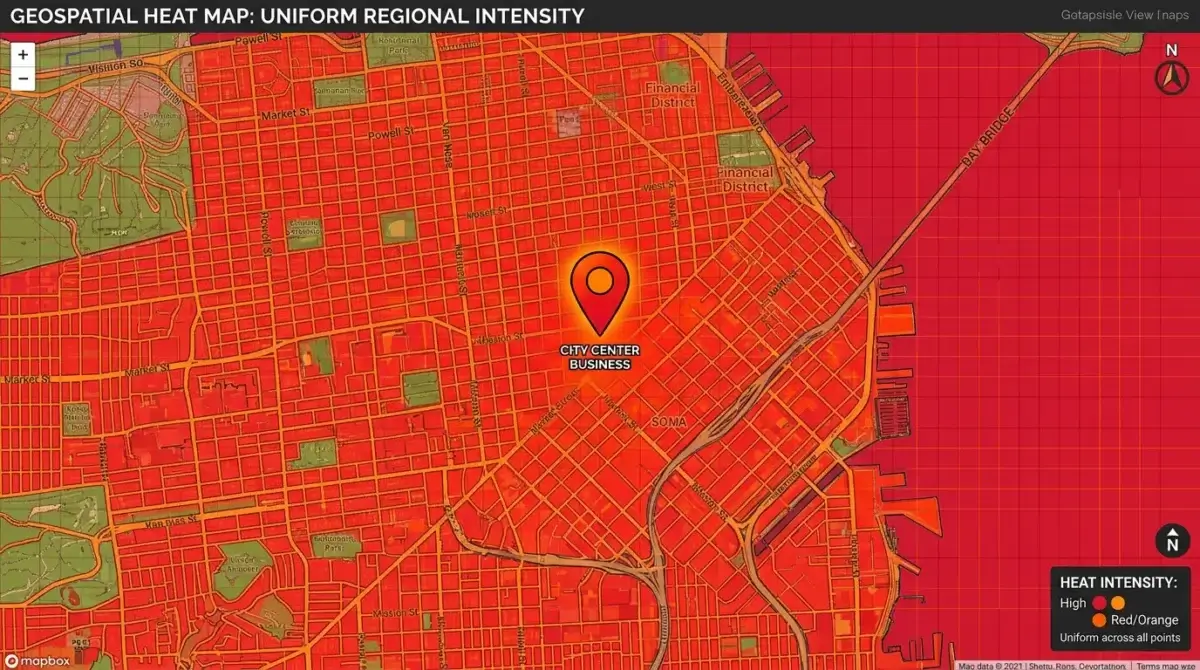
Your rank at your own pin tests relevance
At your own address you have every advantage distance can give you. If you are still not in the pack there, distance is not your problem and prominence is not your problem. Google does not believe you sell the thing being searched for. That is relevance, and it lives in the fields you control completely: primary category, secondary categories, the services list, the description, and the words your customers use in their reviews. A wrong primary category produces exactly this picture — flat, low, everywhere, including at home.
This is the only pattern I treat as urgent, and it is also the cheapest to fix. Most of the time it is one field. I cover the category work in detail in the Google Business Profile guide, and it is the first thing I check in any SEO audit.
The radius of your green tests prominence
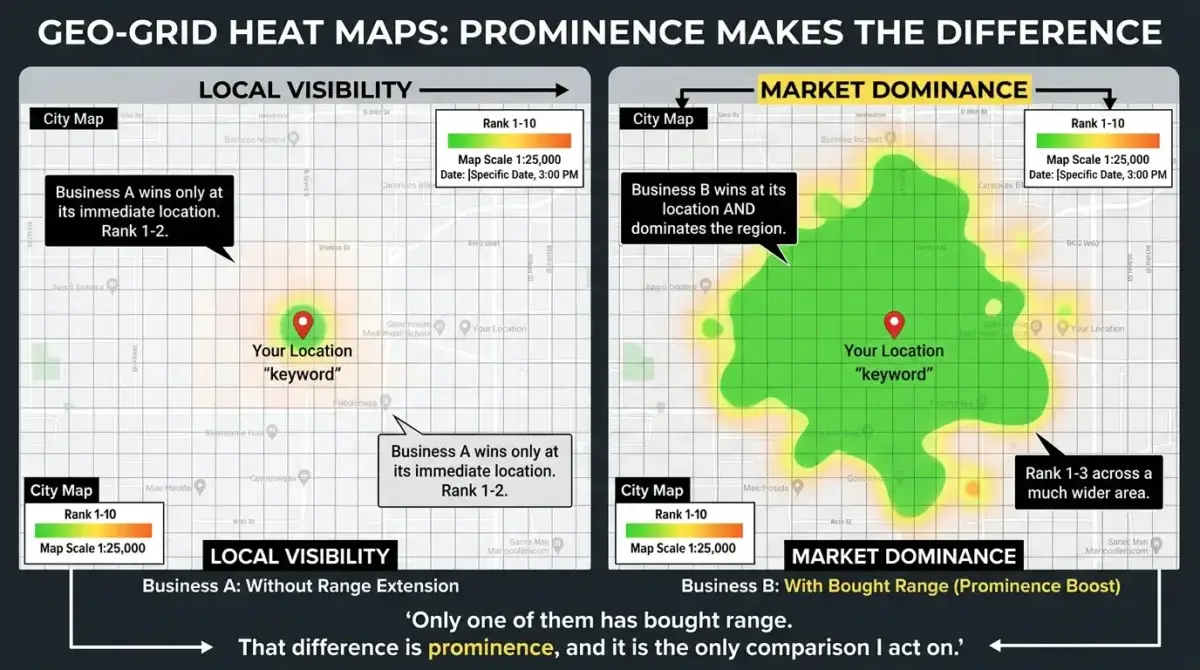
Now scan a competitor on the identical grid. If you are both strong at your own pins but their green reaches four miles and yours reaches one, distance has been held constant and relevance has been held constant. What is left is prominence: review volume and recency, citations that agree with each other, links, and the strength of the website the profile points at.
Prominence is what buys you range. It is the factor that lets a listing hold a position past the point where proximity alone would have dropped it. It is also the slowest to build and the hardest for a competitor to copy, which is why I would rather a client have a small green circle that is growing than a big one built on something fragile. The work is earning reviews steadily and within the rules, keeping citations consistent, and making the site behind the profile genuinely strong — which is the technical and content side of the same job.
The direction of your dead zones tests competitive geography
Fades are not always round. A grid that is strong north and dead south is usually not telling you anything about your profile. It is telling you that somebody with a strong listing sits to the south, and inside their ring you lose the same way they lose inside yours. That is not a defect. It is the map working.
What you do with a lopsided fade is different from what you do with a tight one. You look at who owns the dead sector, you decide honestly whether that ground is worth contesting, and if it is, you contest it with the website and with real local presence rather than by fiddling with the profile. A single pin cannot be in two places. A site can have a page for both.
| Pattern on the grid | What it indicts | Where the work goes |
|---|---|---|
| Green at pin, smooth symmetric fade, radius similar to competitors | Nothing. This is distance behaving | City and service pages on the website |
| Red or weak at your own pin | Relevance | Primary category, services list, description |
| Fade far tighter than a competitor’s on the same grid | Prominence | Reviews, citations, links, site strength |
| Strong one direction, dead the opposite direction | Competitive geography, not you | Decide if the sector is worth contesting, then use pages |
| Flat and low across every point | Eligibility | Duplicates, suspension, name violations, wrong category |
| Green at pin, green far out, dead ring between | Probably the scan, not the business | Re-run before changing anything |
Mistakes People Make Reading Grids
- Scanning the brand name. You will be green everywhere. You have learned nothing except that Google knows your name.
- Chasing individual red squares. One bad point inside a healthy field is noise. Patterns are signal, pixels are not.
- Scanning while signed in. Your own account has years of history with your own business. Use a signed-out window.
- Comparing your scan today to a competitor’s scan last month. Local results move. If the two scans are not from the same day, the comparison is decorative.
- Treating coverage as revenue. Green over ground where nobody lives is worth nothing. Weight the map by where your customers actually are.
- Changing three things at once, then re-scanning. You will never know which one moved it. Change one, wait, measure.
- Expecting the fade to go away. It will not. The goal is a wider fade, not a flat map.
So What Do You Actually Do About It
It depends entirely on which fingerprint your grid left, which is the point of running one. But the pattern across my client work is consistent enough to state plainly.
If the fade is normal and you want more ground, the profile is not the lever. The website is. Real pages for the services you sell and the towns you serve, structured data tying the site and the profile together as one business, and enough authority behind them to carry you past the point where proximity stops helping. That is local SEO and content, not profile housekeeping.
If the fade is tight relative to your competitors, it is a reputation and prominence problem, and it is slow and it is worth it.
If you are weak at your own pin, stop reading and go look at your primary category. That one I would fix before lunch. Profile management is where that work lives, and if somebody else is holding your listing hostage, that is a separate and solvable problem.
Send me your business name and I will run the grid
I will scan your money keyword across your actual service area, scan your top competitors on the identical grid, and tell you which of the three factors your shape indicts. You get the findings whether or not you hire me, and there is nothing to sign.

Who Wrote This
I am David Cragg. I have been in search since 1990, which is long enough that I was optimizing for AltaVista before Google existed and have watched this particular product change its name three times. I hold a BA in Economics from UCLA and an MBA in Marketing from the University of Washington. I founded and sold two internet marketing companies, Lotus411 and MSD2D, started Temecula SEO in 2007, and moved the practice to Tucson in 2022.
I keep a small client roster on purpose and do every part of the work myself — the writing, the schema, the CSS, the profile, the scans. The grids I describe above are ones I ran, on profiles I log into, including a junk hauling company and a dental practice in Southern California and service businesses here in Southern Arizona. More about my background, including the filings and press you can check, and why people hire me instead of an agency.
What Clients Say
Dave does much more than “just” SEO, or at least he does everything even tangentially related to SEO. Not just finding keywords and maximizing them, but rather looking at things at their foundation so we get the best possible results. Dave is very hands-on and blazingly fast with execution. He manages to explain what I need explained in a “for dummies” level but without making me feel like an idiot.
Marc Rowen 5.0 Google review, Temecula SEO profileDavid built and developed the website for my business. His customer service and expertise are superior to anyone else I had previously used. How many web development guys had I been through that promise the moon, work hard for a short while, then become difficult to get a hold of later? I’ll tell you: there were 9 in 7 years! If you want an SEO guy you can count on, David with Temecula SEO is your man!
Leo Rich Severns Master Technician · 5.0 Google review, Temecula SEO profileWe have worked with David for over a year now and he is great to work with. David has built us a great new website that we love and our Google ranking has improved significantly. David is a great guy and works day and night to help you. I highly recommend Temecula seo. Thank you David for your hard work.
Jason Moat 5.0 Google review, Temecula SEO profileDavid at TemeculaSEO is a unique professional. He has been in the industry almost longer than the web has been around. He cares about my success and spends as much time as it takes to make my business succeed. I wish that I could afford to pay him more.
Dr. Ryan Marshall, D.C. 5.0 Google review, Temecula SEO profileRelated Reading
The profile itself
Extending your reach
Questions About Grid Rank and Map Pack Fade
How far out should my grid extend?
To the edge of where you would genuinely take the job, not the edge of where you wish you ranked. For a storefront in a dense corridor that is usually two or three miles in each direction. For a truck-based service business it is often eight to twelve.
Extending a grid past your honest service area does not reveal opportunity. It reveals that you are far away from places you were never going to serve, and it drags your average rank and coverage numbers down for no reason.
How often should I run a grid scan?
Monthly for a baseline. Local results shuffle on their own, so weekly scanning mostly produces movement you will misread as cause and effect.
The exception is a deliberate change. If you switch a primary category, rebuild a services list, resolve a duplicate listing or recover from a suspension, scan before and scan two to four weeks after, and change only that one thing in between.
What does a normal Map Pack fade look like?
Roughly concentric. Strongest at or near your pin and weakening at about the same rate in every direction. How far the strong zone reaches depends on how many competitors share your category and how tightly they are packed, not on how well you are doing.
The shape is what matters, not the size. A smooth symmetrical fade is healthy even when it is small. A map that is weak at your own address, or lopsided, or flat everywhere, is the one worth investigating.
Can I check my Maps position from another location without paying for a tool?
Yes. Chrome’s developer tools include a Sensors panel that lets you override your browser’s geolocation with any latitude and longitude, and Google documents the feature publicly. Right-click a spot in Google Maps to copy its coordinates, paste them in, then run your search on Google Maps in a signed-out window.
Six or seven points gathered that way will not produce a report, but they will tell you whether your fade starts close in or far out and whether the same competitor is beating you from every direction. That is usually enough to know what to do next.
Why do two grid scans run the same week disagree?
Because there is no single true Map Pack ranking to measure. Results are personalized, shuffled, and sampled from slightly different coordinates at slightly different zoom levels depending on the tool, so a position or two of drift between scans is ordinary rather than alarming.
Judge the shape and the trend, not the decimal. If two scans a week apart show the same fade pattern with different numbers inside it, nothing changed. If the pattern itself changed, something did.
Does searching in incognito show my real ranking?
It removes your account history, which is worth doing, but it does not remove your location. An incognito window still searches from wherever you physically are, so it will still flatter a business owner standing inside his own building.
Use incognito and a geolocation override together. The incognito window handles who Google thinks you are; the override handles where Google thinks you are standing. You need both to see what a stranger across town sees.
What grid pattern means my primary category is wrong?
Flat and low across the whole grid, including at your own address. At your own pin you have every advantage that proximity can give you, so failing there means Google does not associate your profile with the thing that was searched.
Check your primary category against the categories printed under the top three listings for that search, and check that the specific service is broken out as its own entry rather than buried in a generic one. A wrong or overly broad category is the most common cause I find, and it is usually a ten-minute fix.
Can a service-area business widen the green on its grid?
Yes, but not by widening the service area setting. Listing every town you would theoretically drive to dilutes the profile rather than extending it, and Google discounts most of it anyway.
Range past your pin is bought with prominence and with the website. Steady recent reviews, citations that agree character for character, and a real page for each service and each town you actually cover. That combination is what lets a listing hold a position at a distance where proximity alone would have dropped it.
Sources
- Google Business Profile Help: tips to improve your local ranking on Google. Source for relevance, distance and prominence, and for distance being measured from the searcher.
- Chrome DevTools: emulate device sensors. Source for the geolocation override method described above.
- Chrome DevTools: saved location presets. Source for storing your own check points, including copying coordinates from Google Maps.
- BrightLocal: geo-grid ranking tool comparison guide. Survey of the grid tools currently available.
- Local Falcon features. Reference for grid scanning, coverage and share of local voice metrics.
- Google Search Central: local business structured data. Source for tying a website and a profile together as one entity.
Google adjusts how it weights local signals regularly. Relevance, distance and prominence have held steady for years; the weighting inside them has not. If something here has gone stale, tell me and I will fix it.
AI disclosure: I use AI tools in research and drafting. Every page on this site is reviewed, edited, and verified against live source by David Cragg before it publishes.
Find Out What Your Grid Actually Says
Tell me the business name and the one search that brings you work. I will run the grid, run your competitors on the same grid, and tell you honestly whether you have a problem or a normal fade. No charge and no pitch. If I do not think I can move it, I will say so.
Tucson SEO, formerly Temecula SEO
Consultant: David Cragg, in search since 1990
Phone: (520) 207-6000
Serving Tucson, Oro Valley, Marana, Sahuarita, Green Valley, Vail, the Catalina Foothills and Southern Arizona
$1,000 a month, month to month, no contract.
Page last reviewed September 20, 2026 by David Cragg.